The 10 Best Performing US Stocks of the First Half of 2026
This image is used under our Editorial Policy.
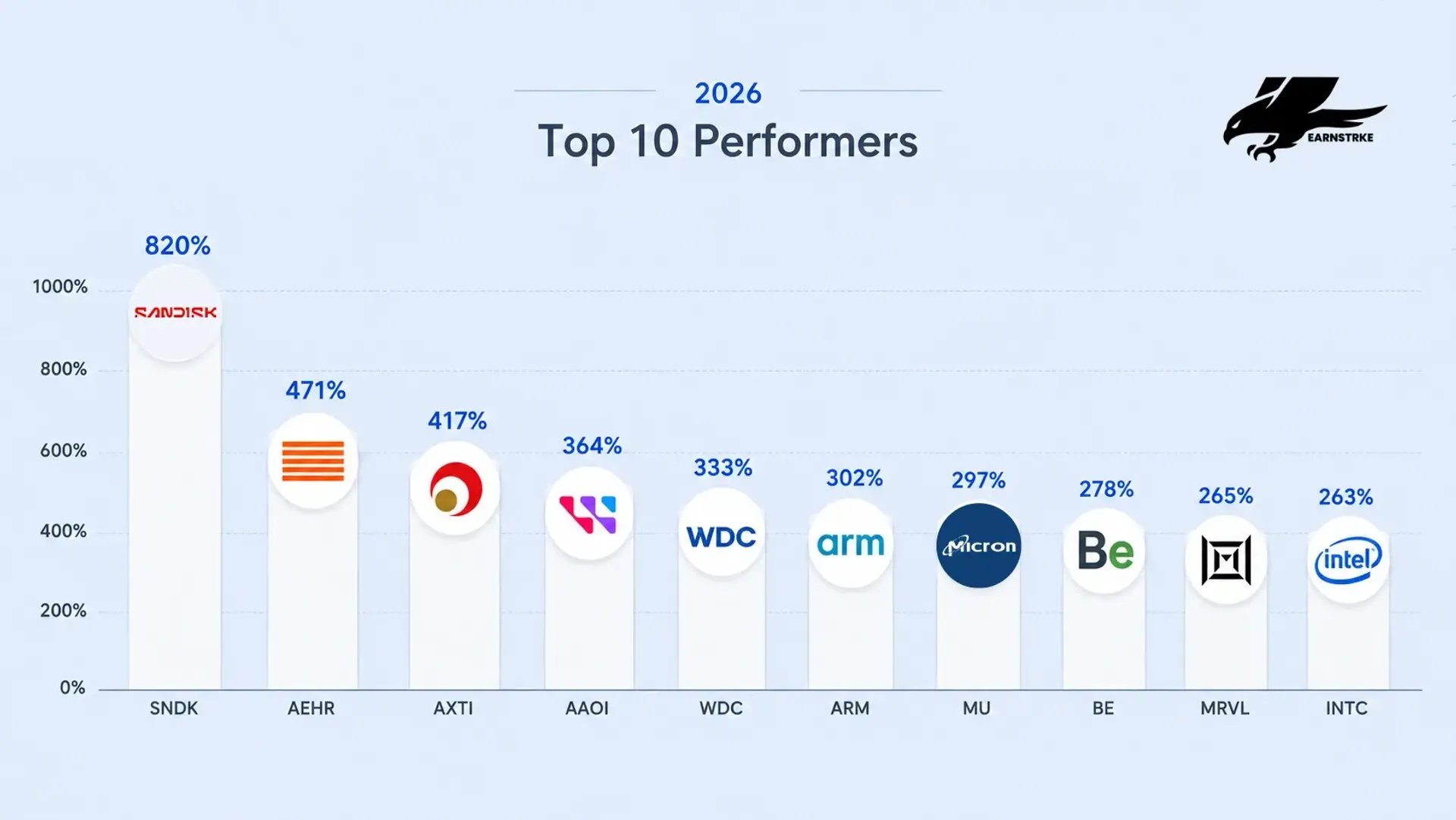
In the first half of 2026, 10 stocks delivered gains ranging from 263% to 820%, driven by explosive AI data center demand that triggered shortages in memory chips, chip-testing equipment, and on-site power — reshaping the semiconductor sector and producing the most concentrated cluster of triple-digit winners since 2021.
The AI infrastructure trade didn't just lift the obvious names. It rewarded pick-and-shovel plays: the companies making the NAND flash, the burn-in test systems, the optical substrates, and the fuel cells that keep data centers running when the grid can't. Almost every name in the top 10 fits that description.
Who Are the Top 10 Stock Performers of H1 2026?
- SanDisk (SNDK) +820% — The clearest AI trade of the year. The company spun out of Western Digital in February 2025 at around $38.50 a share. It didn't stay cheap. Q3 2026 revenue hit $5.95 billion, a 251% jump, on the back of AI data center demand for NAND flash and enterprise SSDs. Gross margin sits near 56%. The company has since secured over $42 billion in contracted orders.
- Aehr Test Systems (AEHR) +471% — A niche semiconductor equipment maker that landed at the center of a major AI spending wave. Its FOX-XP wafer-level burn-in systems test the silicon photonics chips inside AI data center optical transceivers. Repeat orders from a major hyperscaler supplier confirmed scaling production and sent the stock soaring.
- AXT Inc. (AXTI) +417% — A substrate materials supplier riding the optical communications boom. AXT makes indium phosphide — a compound semiconductor used in the high-speed optical transceivers connecting AI servers. Record deliveries expected in Q2 2026, with one of the most aggressive capacity expansion plans in the industry.
- Applied Optoelectronics (AAOI) +364% — Optical networking components. As hyperscalers scale AI clusters, demand for high-bandwidth fiber optic transceivers has grown in lockstep. AAOI's market cap pushed close to $15 billion by mid-2026.
- Western Digital (WDC) +333% — After spinning off SanDisk in 2025, WDC refocused on hard disk drives for mass storage. Right place, right time. The company is now reporting some of the highest gross margins in its history, with multiple Wall Street analysts raising price targets above $650.
- Arm Holdings (ARM) +302% — Arm is rewriting its own story. In March 2026 it unveiled its first in-house AI chip, the AGI CPU, pivoting after 35 years of purely licensing designs. Mizuho now sees a path to $15 billion in agentic AI CPU revenue by 2031 and set a Street-high $500 price target.
- Micron Technology (MU) +297% — One word: HBM. High-bandwidth memory — the specialized DRAM stacked directly on AI accelerators — is Micron's golden ticket. Its entire 2026 HBM capacity is sold out under binding contracts. Fiscal Q1 revenue came in at $13.6 billion with a 56.8% gross margin and $3.9 billion in free cash flow. Micron has since crossed a $1 trillion valuation.
- Bloom Energy (BE) +278% — The only non-semiconductor name in the top 10, and arguably the most interesting story. Bloom makes solid oxide fuel cells — on-site power generators for data centers that can't wait for grid capacity. Oracle contracted up to 2.8 GW of Bloom fuel cell capacity for its AI campuses. CEO KR Sridhar put it simply: "Bring your own power has become the mantra for data centers."
- Marvell Technology (MRVL) +265% — Marvell designs the custom silicon and networking chips that stitch AI infrastructure together. Record Q1 FY27 revenue of $2.418 billion, up 28% year-over-year. Then Nvidia CEO Jensen Huang called Marvell "the next trillion-dollar company" at Computex 2026 and backed it with a $2 billion investment. The stock hasn't looked back.
- Intel (INTC) +263% — The biggest comeback story of 2026. CEO Lip-Bu Tan cut headcount by 32%, stabilized the balance sheet, and started shipping on the 18A process node. Intel posted its best single-day performance since 1987 after Q1 earnings. The latest catalyst: reports that Apple is in talks to manufacture chips with Intel, a potential foundry win that would validate the entire turnaround thesis.
What's the Common Thread?
Every name on this list feeds the same pipeline. AI spending flows downstream to chip designers, memory makers, optical component suppliers, test equipment makers, and power providers. In the past six months alone, 12 stocks have gained over 100% — more than double the ten-year average — with the vast majority tied directly to the AI infrastructure boom, according to Morningstar.
Honorable mentions
- DigitalOcean (DOCN) +261%
- Penguin Solutions (PENG) +243%
- Nebius Group (NBIS) +243%
- Navitas Semiconductor (NVTS) +236%
- Dell Technologies (DELL) +225%
FAQ
What was the best-performing stock in the first half of 2026?
SanDisk (SNDK) was the top performer in H1 2026 with a gain of approximately 820%. The company spun off from Western Digital in February 2025 and surged on explosive AI data center demand for NAND flash memory, combined with a structural supply shortage that pushed contract prices sharply higher and drove record margins.
Why did so many semiconductor stocks surge in 2026?
AI infrastructure spending hit unprecedented levels, with major hyperscalers committing over $700 billion in combined capital expenditure for 2026. That spending created simultaneous shortages across memory chips, optical components, and semiconductor substrates — rewarding companies across the entire supply chain, not just the headline GPU makers.
What is high-bandwidth memory and why does it matter for investors?
HBM is a type of DRAM stacked in multiple layers directly alongside AI accelerator chips. It delivers far more bandwidth than standard memory and is essential for running large AI models. Only three manufacturers exist globally — Micron, SK Hynix, and Samsung — giving the group unusual pricing power during a period of sold-out supply.
Why did Bloom Energy make a list dominated by chip stocks?
Bloom's fuel cells generate power on-site at data centers, solving a critical problem: AI data centers consume enormous electricity, and many locations can't get grid capacity fast enough. Its multi-gigawatt Oracle partnership confirmed it as infrastructure, not just a clean energy story — and investors repriced it accordingly.
What is the biggest risk for these top performers in H2 2026?
Valuation. Almost every stock has appreciated faster than underlying earnings, pricing in years of continued AI spending growth. Any slowdown in hyperscaler capex, a resolution of supply shortages, or a miss on earnings could trigger sharp corrections. These are high-conviction, high-beta names — the gains are real, but so is the downside.
Stock investments involve market risk and price fluctuations. This content is for informational purposes only and should not be considered investment advice. Please read our Disclaimer for more information.