Is Photonics the Biggest Infrastructure Bet of the Decade?
This image is used under our Editorial Policy.
In 2026, the global AI optical transceiver market surpassed $26 billion — a 57% jump from $16.5 billion in 2025 — as data centers began ripping out copper wiring and replacing it with fiber optic systems capable of moving data at the speed of light.
Copper wire has run the world for over a century. What's happening right now inside AI data centers is the beginning of the era that replaces it.
Why Is Copper Failing AI Data Centers?
The problem is physical. Inside a modern AI data center, thousands of chips have to talk to each other constantly and at extraordinary speed. For a hundred years, machines did this the same way: electricity down copper wires. That always worked. Until AI.
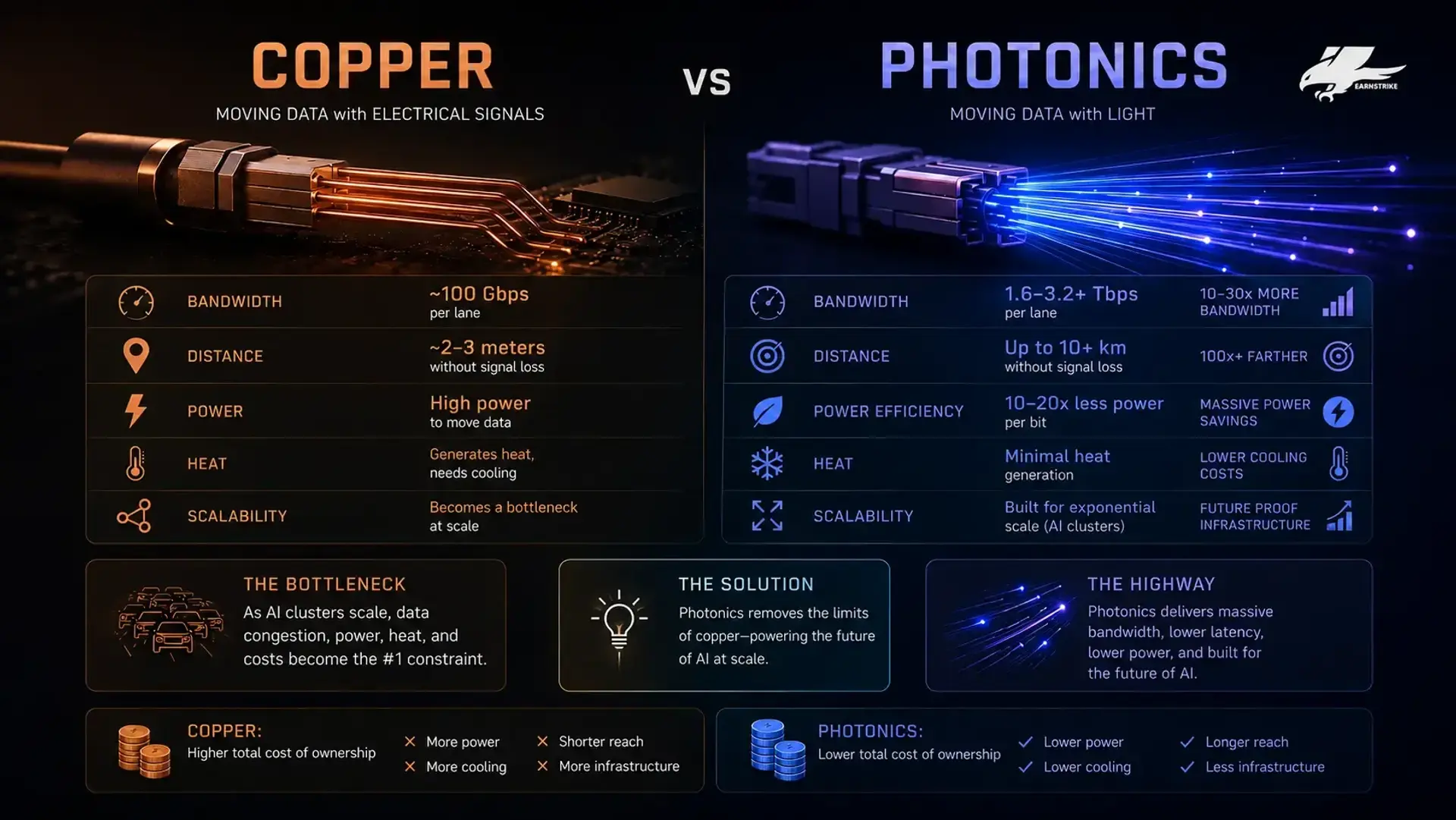
The chips now move so much data so fast that copper physically cannot keep up. Push electricity that hard down a wire and it turns into heat. The signal falls apart. It can barely cross a single server rack before it dies.
So the entire industry is switching to light. Instead of electricity down a wire, data travels as pulses of light through glass fiber. Light runs cooler, travels farther, and carries vastly more information. Photonics is the technology that makes this possible — embedding optical components into chips and modules that convert electricity into light and back again.
The numbers make the case. Copper tops out at around 100 gigabits per second per lane and loses signal after 2 to 3 meters. Fiber carries 1.6 to 3.2 terabits per second — 10 to 30 times more bandwidth — and travels over 10 kilometers without signal loss. It also uses 10 to 20 times less power per bit. In a world where power and heat are the limits on how much AI you can build, that's not a preference. It's the only path forward.
How Big Is the Market Opportunity?
The upgrade cycle is moving faster than any previous generation of networking technology. The industry went from 400G to 800G — the current workhorse, already shipping in the tens of millions. Now it's climbing to 1.6T, double the bandwidth in the same physical space, with Nvidia's newest systems requiring over 160 of these modules per single rack. After that comes 3.2T, doubling it again.
What used to be a five-year upgrade cycle has collapsed to one or two years. And these generations aren't replacing each other one at a time. 800G, 1.6T, and 3.2T are ramping simultaneously.
The prize is substantial. The global AI optical transceiver market hit $26 billion in 2026, up 57% in a single year. The silicon photonics segment inside that market — the chips that embed optical functions directly onto silicon — is on its own steep trajectory, heading from under $1 billion toward $6 billion by 2030. Traffic at hyperscale data centers in North America has sustained over 30% annual growth, pushing cloud giants including Google, Microsoft, and Meta to keep expanding procurement of high-speed optical interconnects. This is a market doubling, and then doubling again, driven by a buildout that has barely started.
Which Companies Are Positioned to Win?
Every company that makes the lasers, the chips, and the modules that turn electricity into light gets paid on every step up that upgrade staircase, for years. Here's who sits where in that chain.
Applied Optoelectronics (AAOI) is the vertically integrated laser play. Most competitors buy their lasers from outside suppliers — AAOI makes its own in-house. That matters because laser supply is the single biggest bottleneck right now. The company exited Q1 2026 at roughly 100,000 transceivers a month and has guided to over 930,000 a month of 800G and 1.6T by end of 2027, while expanding laser fabrication capacity by about 350% over the same window. The stock is up over 390% year-to-date.
Credo Technology (CRDO) makes the connectivity chips that keep blazing-fast optical links clean and reliable. Fiscal Q3 2026 revenue reached a record $407 million, up more than 200% year-over-year, with gross margin at 68.6% and free cash flow at $139.7 million. Management expects fiscal 2027 revenue growth above 50%.
Lumentum (LITE) and Coherent (COHR) are the photonics giants supplying lasers and transceivers that the entire industry depends on. Lumentum's fiscal Q3 2026 revenue guidance implied over 85% year-over-year growth. Coherent reported fiscal Q3 revenue of $1.81 billion, up 21% year-over-year, with its data center segment growing 41% and now representing 75% of total revenue. LITE is up 138% and COHR up 107% year-to-date.
Marvell (MRVL) and Broadcom (AVGO) build the custom silicon at the center of it all — the DSP chips and signal processors that handle electrical-to-optical conversion inside AI networking fabrics. Marvell recently acquired Celestial AI to deepen its photonics capabilities and is up 228% in 2026.
What Are the Risks?
These stocks are not cheap. The sector is volatile — single-day swings of 10% in either direction have become routine for LITE, COHR, and AAOI. In early June, a bearish institutional research note on co-packaged optics timelines sent the whole group down sharply in a single session before bouncing back overnight.
Co-packaged optics — the next-generation approach that embeds optical conversion directly onto the switch chip — is still a few years from mass deployment. When it arrives, it could disrupt the pluggable transceiver market that drives most of today's revenue. The technology roadmap is real; the timeline is the debate.
The AI infrastructure buildout has layers. Most investors have already priced the computing power layer. The photonics interconnect layer is getting priced now. The optical computing power layer is still early. Understanding where you are in that stack matters a lot for how you size a position.
FAQ
What is photonics and how does it differ from copper wiring?
Photonics is the technology of transmitting data as pulses of light through glass fiber rather than as electrical signals through copper wire. Copper tops out at around 100 gigabits per second per lane and degrades over just a few meters. Fiber carries 10 to 30 times more bandwidth, travels over 10 kilometers without signal loss, and uses far less power — a critical advantage as AI data centers strain power grids.
Why is the copper-to-photonics shift happening now?
AI clusters require thousands of chips to communicate simultaneously at speeds copper cannot sustain without generating excessive heat and signal loss. The shift is being forced by physics, not preference. As GPU clusters scale to hundreds of thousands of accelerators, fiber optics is the only interconnect technology that can keep up without melting the rack.
What is silicon photonics and how is it different from traditional optics?
Silicon photonics embeds optical components — modulators, detectors, waveguides — directly onto a standard silicon chip using existing semiconductor manufacturing processes. This makes optical components cheaper to produce at scale and enables tighter integration with electronics. It's the key technology behind co-packaged optics, where optical conversion moves from a pluggable module directly onto the switch chip itself.
What is the biggest risk in photonics stocks right now?
Valuation and timing. Most leading photonics names have already posted triple-digit gains in 2026, pricing in years of continued buildout. The sector is also exposed to technology transition risk: co-packaged optics, when it arrives at scale, could disrupt the pluggable transceiver revenue that drives most companies today. The fundamentals are strong, but these stocks move fast in both directions.
Commodities markets can be volatile and affected by global events. This content is for informational purposes only and should not be considered investment advice. Please read our Disclaimer for more information.