DRAM ETF: Why It's Dominating the Market Right Now
This image is used under our Editorial Policy.
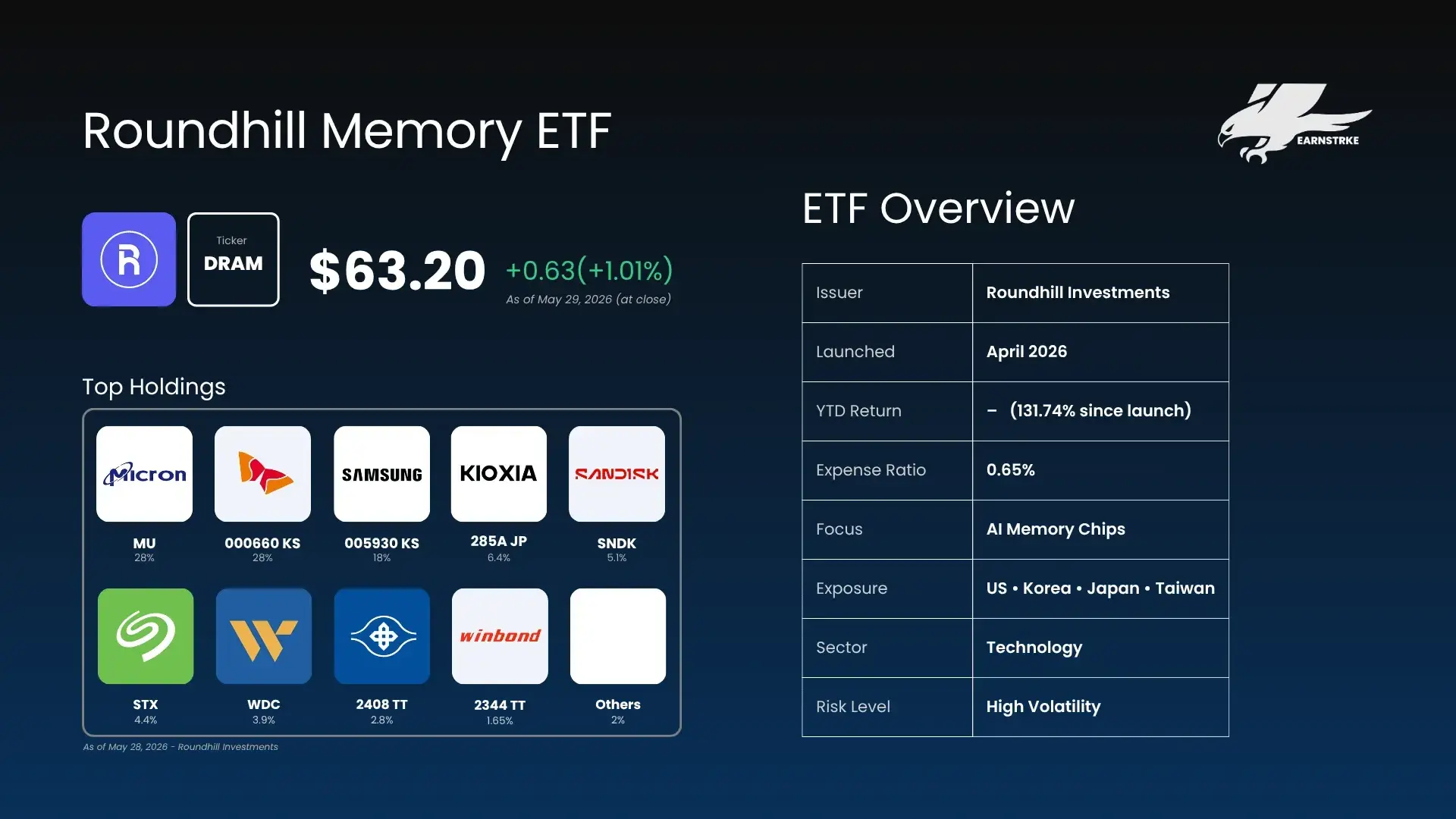
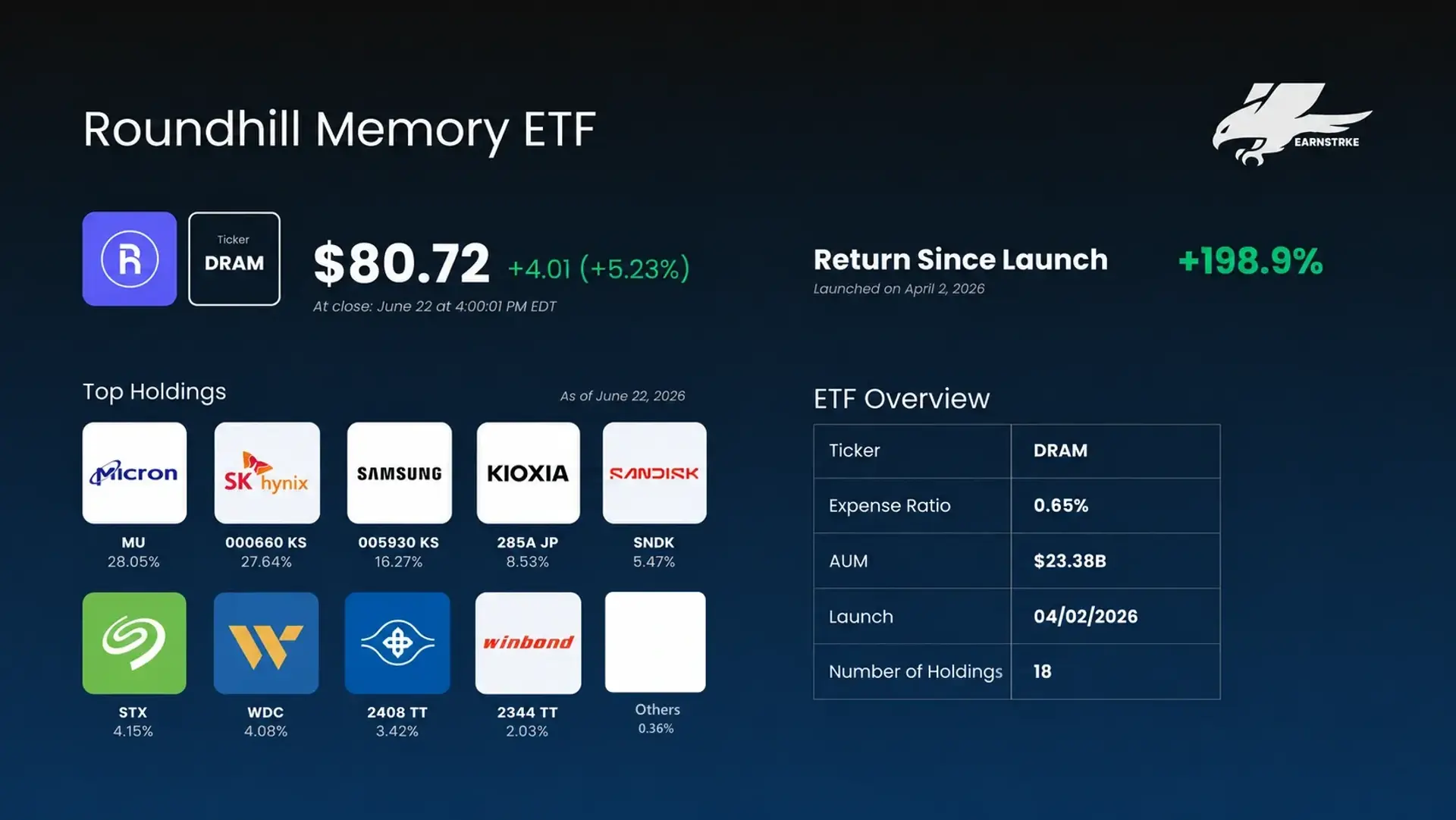
The Roundhill Memory ETF (DRAM) closed at $80.72 on June 22, 2026, up 5.23% on the day, bringing its total return to 198.9% since its April 2, 2026 launch, driven by a global memory chip shortage that's pushed DRAM contract prices up more than 50% year-to-date.
That's not a typo. A fund that launched less than three months ago has nearly tripled. Here's what's actually happening inside the memory chip market, and why this specific ETF is positioned right in the middle of it.
What Is the Roundhill Memory ETF?
DRAM is the first U.S.-listed ETF built entirely around memory chip makers. It launched on April 2, 2026, charges a 0.65% expense ratio, and now holds $23.38 billion in assets across 18 holdings, putting it in rare territory for a fund less than three months old.
The fund is concentrated by design. Three companies make up nearly 72% of total assets:
- Micron (MU): 28.05%
- SK Hynix (000660 KS): 27.64%
- Samsung Electronics (005930 KS): 16.27%
The rest of the portfolio spreads across Kioxia, SanDisk, Seagate, Western Digital, Nanya Technology, and Winbond, among others.
Why Are Memory Chip Prices Exploding Right Now?
The short answer: artificial intelligence data centers need a completely different kind of memory than PCs and phones do, and chipmakers are starving the old kind to build more of the new kind.
High-bandwidth memory, or HBM, is a premium category of DRAM built specifically for AI servers and training clusters. According to S&P Global Market Intelligence, manufacturers are shifting production capacity toward HBM because it carries far higher margins than conventional DRAM, the standard memory used in laptops, smartphones, and everyday servers.
The problem is that HBM and conventional DRAM are often made on the same production lines. Every wafer redirected to HBM is one less wafer making the memory that goes into a regular PC or phone. A Micron executive cited by Network World pegged that tradeoff directly: HBM production consumes roughly three times the wafer capacity of standard DRAM per gigabyte.
How Much Have Prices Actually Risen?
The numbers are extreme even by semiconductor industry standards. Market researcher TrendForce projected conventional DRAM contract prices to rise 55% to 60% in a single quarter, with server-specific DRAM climbing more than 60% over the same period.
Some specific data points show the scale:
- A 64GB RDIMM server memory module rose from roughly $450 in Q4 2025 to more than $900 in Q1 2026, according to Counterpoint Research
- Samsung raised prices on 32GB DDR5 modules to $239 from $149, a 60% jump, per Network World's reporting
- DDR5 contract pricing surged from around $7 per unit to $19.50 per unit
- Counterpoint Research data shows global memory prices rose 80% to 90% quarter-on-quarter in Q1 2026 alone, the highest level on record across every memory category
"Demand for memory is strong, driven by ongoing AI investments," said Kanishka Chauhan, senior principal analyst at Gartner. Chauhan added that high-bandwidth memory demands stronger pricing than legacy memory, which is exactly why manufacturers keep redirecting capacity toward it.
Who's Actually Winning From This?
The three companies inside DRAM's top holdings are posting numbers that read like typos. Samsung's operating profit jumped 755% year-over-year in a recent quarter. SK Hynix's revenue topped 50 trillion Korean won for the first time, with an operating margin reaching 72%. Micron's net profit surged 770.8% year-over-year, according to data compiled by Ersa Electronics.
All three companies have now crossed the $1 trillion market valuation mark. SK Hynix reported its HBM, DRAM, and NAND capacity is "essentially sold out" through the rest of 2026, and Micron has reportedly exited the lower-margin consumer memory business entirely to focus on enterprise and AI customers.
What's the Risk Hiding Behind This Rally?
Memory has always been a boom-and-bust industry, and this cycle isn't exempt from gravity. Counterpoint Research data, cited in Yahoo Finance's coverage of the sector, shows that memory equities have historically given back 40% to 60% of their gains within six months of a pricing peak.
Two specific signals are worth tracking if you're holding DRAM. Two consecutive months of declining DDR5 contract prices have historically preceded sharp drawdowns in memory stocks, and Micron's new Idaho production facility isn't expected to come online until 2027, meaning meaningful new supply can't arrive fast enough to cool prices anytime soon.
There's also a currency wrinkle most investors miss. Because Samsung and SK Hynix together make up nearly 44% of the fund, DRAM carries real exposure to the Korean won-to-dollar exchange rate, on top of the underlying stock moves.
How Concentrated Is DRAM Compared to a Single Stock?
DRAM isn't really a diversified semiconductor fund. It's closer to a basket of three companies, with smaller satellite positions wrapped around them.
- Top 3 holdings: 71.96% of total assets
- Top 5 holdings: 85.96% of total assets
- Remaining 13 holdings: roughly 14% combined
That structure means DRAM's performance tracks Micron, SK Hynix, and Samsung almost directly. An investor who already owns Micron stock is getting significant overlapping exposure by also holding DRAM.
FAQ
Why has the Roundhill Memory ETF gone up so much since launch?
DRAM launched on April 2, 2026, right as a global memory chip shortage began pushing DRAM and NAND prices sharply higher. Its top holdings, Micron, SK Hynix, and Samsung, have all posted record profits as AI data center demand for high-bandwidth memory squeezes the supply of conventional memory chips.
What's driving the memory chip shortage in 2026?
Chipmakers are redirecting manufacturing capacity toward high-bandwidth memory for AI servers, which carries higher profit margins than standard DRAM. Since HBM production uses roughly three times the wafer capacity per gigabyte, every unit of HBM made reduces the supply of conventional memory available for PCs and phones.
Is the Roundhill Memory ETF too concentrated to be safe?
DRAM holds just 18 positions, with Micron, SK Hynix, and Samsung making up nearly 72% of assets. That concentration amplifies both gains and losses. Investors who already hold one of these stocks individually should know they're getting substantial overlapping exposure through the fund.
Will memory chip prices keep rising?
Analysts are split. TrendForce and Counterpoint data show sustained price increases through at least mid-2026, with some forecasts citing meaningful supply relief unlikely before 2028 due to long fab construction timelines. Historically, memory stocks have dropped 40% to 60% within six months of a price peak, so the cycle has a track record of reversing sharply.
What companies does the Roundhill Memory ETF actually hold?
The fund's top holdings are Micron (28.05%), SK Hynix (27.64%), and Samsung Electronics (16.27%), followed by Kioxia, SanDisk, Seagate, Western Digital, and several smaller memory and storage companies rounding out its 18 total positions.
Stock investments involve market risk and price fluctuations. This content is for informational purposes only and should not be considered investment advice. Please read our Disclaimer for more information.