Invesco Semiconductor ETF (PSI): 2026 Performance Review
This image is used under our Editorial Policy.
Artificial intelligence has created plenty of winners over the last two years, but few investments have captured the trend as effectively as the Invesco Semiconductors ETF (PSI).
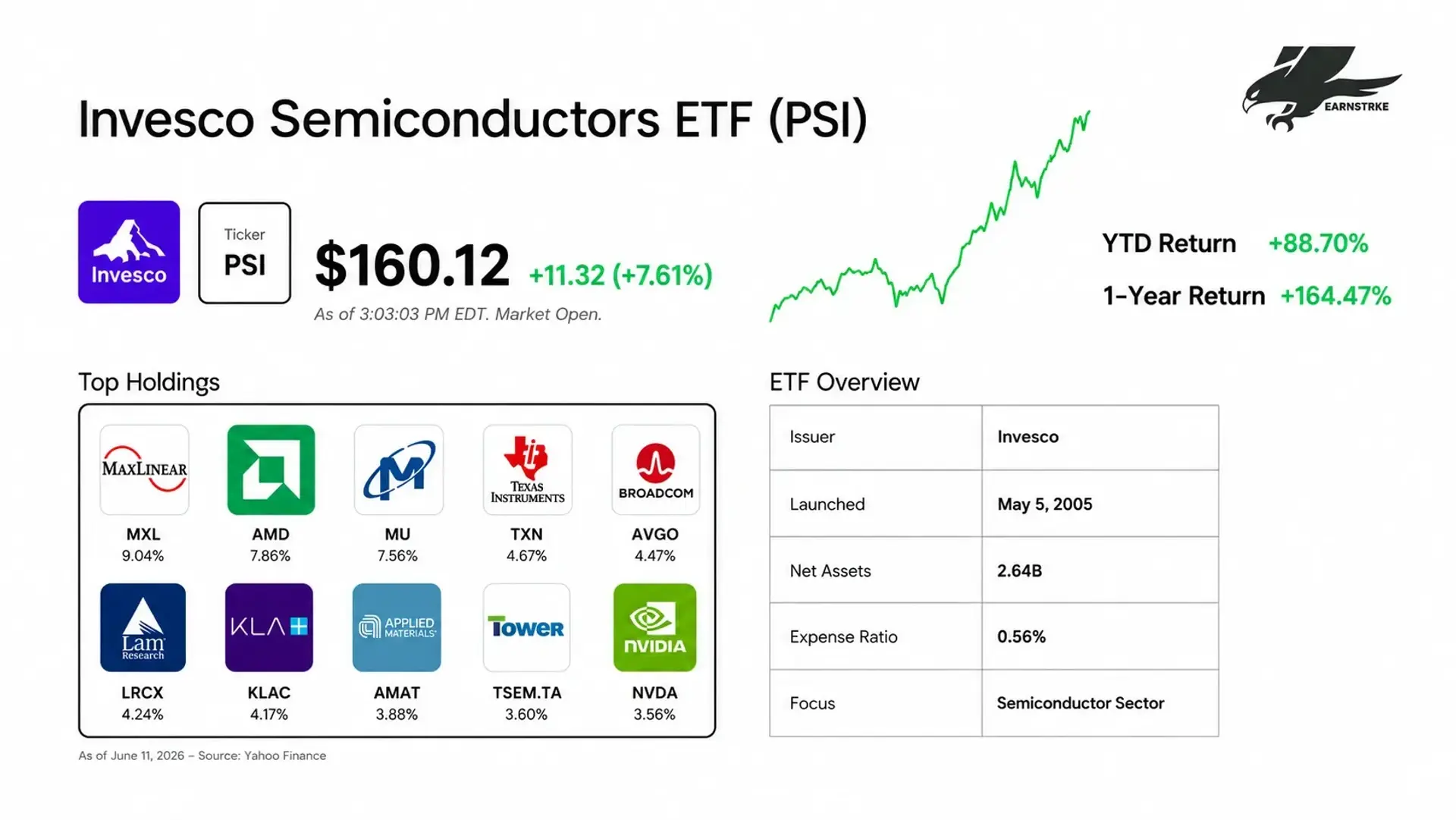
As of June 2026, PSI has delivered a staggering 88.7% year-to-date return and a 164.5% gain over the past 12 months, dramatically outperforming the broader technology ETF category. While many investors focus on individual AI stocks such as NVIDIA or AMD, PSI offers something different: diversified exposure to the companies powering the entire semiconductor ecosystem.
With nearly $2.7 billion in assets under management and a portfolio focused almost entirely on semiconductor-related businesses, PSI has become one of the standout ETF success stories of the AI boom. But what's driving this performance, and can the momentum continue?
Why PSI Has Been Crushing the Market
The answer starts with a simple reality: modern AI cannot exist without semiconductors.
Every AI model, whether it's ChatGPT, autonomous driving software, or enterprise AI systems, requires enormous amounts of computing power. That computing power depends on a vast network of chip designers, memory manufacturers, semiconductor equipment companies, testing firms, and suppliers.
Rather than concentrating heavily in a few mega-cap names, PSI tracks the Dynamic Semiconductor Intellidex Index, which uses a quantitative methodology to select and weight semiconductor companies. This approach often gives more exposure to emerging winners than traditional market-cap-weighted semiconductor ETFs.
That distinction has mattered enormously in 2026. While investors often associate the AI trade with NVIDIA alone, some of the strongest performers have actually come from other areas of the semiconductor supply chain, particularly memory manufacturers and semiconductor equipment providers.
A Different Kind of Semiconductor ETF
Many semiconductor ETFs are dominated by NVIDIA, Broadcom, or Taiwan Semiconductor. PSI takes a more balanced approach.
According to the latest fund data, the largest positions include:
- MaxLinear
- AMD
- Micron Technology
- Texas Instruments
- Broadcom
- Lam Research
- KLA Corporation
- Applied Materials
- Tower Semiconductor
- NVIDIA
Together, the top ten holdings account for just over 53% of assets, giving investors broad exposure across multiple semiconductor segments rather than relying on one company to drive returns.
This diversification has worked exceptionally well because AI spending isn't benefiting only chip designers. Equipment manufacturers such as Lam Research, KLA, and Applied Materials are seeing rising demand as semiconductor companies invest heavily in expanding production capacity. Meanwhile, memory suppliers have become some of the biggest beneficiaries of the AI infrastructure buildout.
The Micron Effect
One reason PSI has performed so well this year is its exposure to Micron Technology.
Memory chips have become one of the most critical components of modern AI systems. High-bandwidth memory (HBM) is essential for training and running large language models, and demand has exploded far faster than supply.
Micron has repeatedly stated that its HBM capacity for 2026 is effectively sold out, highlighting just how tight the market has become. The company has benefited from a structural shortage in AI memory, helping drive one of the strongest stock performances in the semiconductor sector.
Recent analyst commentary suggests that the AI memory cycle remains in its early stages. Some forecasts call for dramatic increases in DRAM pricing due to persistent supply constraints and growing AI-related demand.
For PSI investors, that matters because the fund provides significant exposure to companies benefiting from this trend without requiring investors to bet on a single stock.
The Current Semiconductor Market Pullback
Despite its incredible performance, PSI hasn't been immune to volatility.
Over the past few weeks, semiconductor stocks have experienced a sharp correction after Broadcom's latest earnings report. Although Broadcom reported impressive AI-related growth, investors had expected even stronger guidance. The result was a sector-wide selloff that affected many semiconductor names.
At first glance, this pullback may seem concerning. However, many analysts believe the decline reflects excessively high expectations rather than a deterioration in AI demand. Several industry observers argue that the underlying drivers of semiconductor growth remain intact, including hyperscaler spending, AI data center construction, and continued demand for advanced memory solutions.
In fact, some market participants view the recent weakness as a healthy reset after one of the strongest rallies the semiconductor industry has ever experienced.
AI Spending Is Still Growing
The long-term investment case for PSI largely depends on whether AI infrastructure spending continues.
So far, there are few signs of a slowdown. Major technology companies are still investing hundreds of billions of dollars into AI infrastructure, including data centers, networking equipment, GPUs, and memory systems. Rising memory costs have even become one of the biggest drivers of AI infrastructure expenses, reflecting how strong demand remains throughout the supply chain.
This environment benefits not only NVIDIA but also the less glamorous companies that supply equipment, memory, testing systems, and manufacturing tools. Many of those businesses are represented inside PSI.
That broad exposure may ultimately be one of the ETF's greatest strengths.
Is PSI Still Worth Watching?
After an 88% year-to-date gain, it's fair to ask whether PSI has already had its run.
The reality is that semiconductor stocks remain cyclical, and investors should expect volatility. A fund with a beta above 2 can move sharply in both directions. The same characteristics that helped PSI outperform during the AI boom could amplify losses during industry downturns.
However, the broader AI infrastructure story remains compelling. Semiconductor demand continues to expand beyond consumer electronics and into data centers, enterprise AI systems, autonomous technologies, robotics, and cloud computing.
Rather than trying to identify the next semiconductor winner, PSI gives investors exposure to many of the companies building the foundation of the AI economy.
That approach has worked exceptionally well so far.
Whether the next twelve months look anything like the last twelve remains uncertain, but one thing is clear: few ETFs have benefited from the AI revolution as much as the Invesco Semiconductors ETF, and it remains one of the most closely watched vehicles for investors seeking broad exposure to the semiconductor industry.
Stock investments involve market risk and price fluctuations. This content is for informational purposes only and should not be considered investment advice. Please read our Disclaimer for more information.