iShares Core High Dividend ETF HDV Yield: Worth It in 2026?
This image is used under our Editorial Policy.
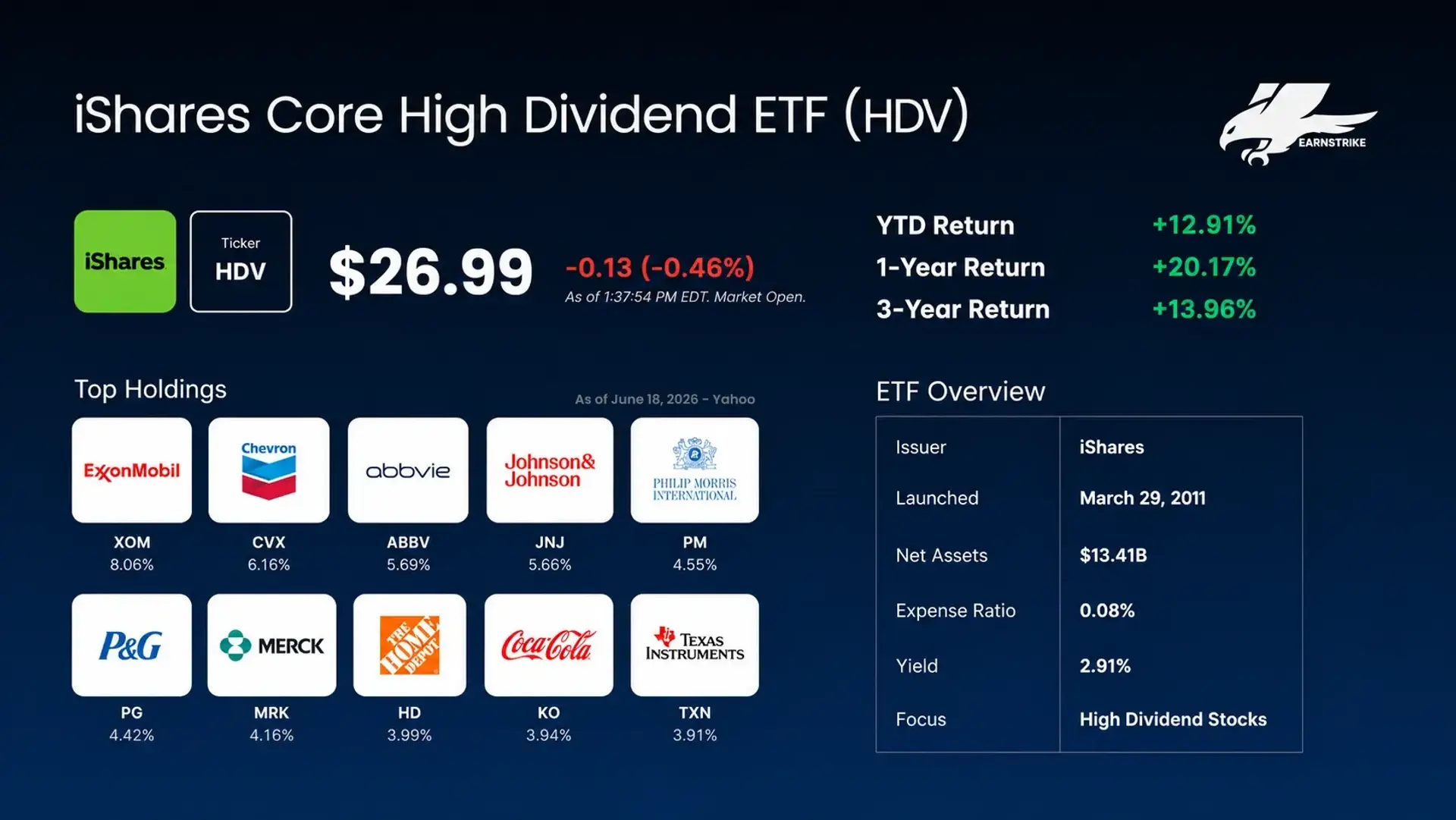
The iShares Core High Dividend ETF (HDV) traded at $26.97 on June 18, 2026, down 0.53% on the day, holding $13.41 billion in assets across a concentrated basket of 75 U.S. companies whose top 10 names — from Exxon Mobil to Texas Instruments — account for over half the fund's total weight.
Most coverage of HDV stops at the yield and expense ratio. That misses the real story: this fund is essentially a curated bet on 10 specific companies dressed up as diversification. If you own HDV, you need to know what you actually own.
What Is HDV and How Does It Work?
HDV tracks the Morningstar Dividend Yield Focus Index. That index screens U.S. companies for high dividend yields combined with financial health — it's not just chasing the biggest payers, it filters for sustainability too. BlackRock manages the fund under its iShares brand.
The expense ratio is 0.08%. That's $8 per year on a $10,000 investment. The trailing 12-month yield sits at 2.91%, with a 30-day SEC yield of 2.98% as of May 31, 2026, according to BlackRock.
The fund's beta over five years is just 0.33 against the S&P 500. That means HDV moves at roughly a third of the market's volatility — on paper, at least.
What Are HDV's Top 10 Holdings Right Now?
This is where most investors should spend their time. The top 10 holdings make up 50.54% of total assets. Here's what you're actually buying:
- Exxon Mobil (XOM) — 8.06%: The fund's largest position. Exxon pays a quarterly dividend of $1.03 per share, annualizing to $4.12 and a yield of roughly 2.93%. The company distributed $9.2 billion to shareholders in Q1 2026 alone, including $4.3 billion in dividends and $4.9 billion in buybacks, according to its own earnings release.
- Chevron (CVX) — 6.16%: The second oil major in the top two slots. Chevron anchors the fund's energy exposure alongside Exxon, giving HDV a combined 14.22% in just two fossil-fuel stocks.
- AbbVie (ABBV) — 5.69%: The pharmaceutical giant pays $1.73 per share quarterly, annualizing to $6.91 and a yield of around 3.07%. AbbVie has raised its dividend for 12 consecutive years and increased its quarterly payout by 204% over the past decade, according to its 2026 proxy filing.
- Johnson & Johnson (JNJ) — 5.66%: J&J carries a 2.17% yield and a 47% payout ratio, meaning it pays out less than half its earnings as dividends — leaving room to keep growing. It has raised its dividend for 64 straight years, making it one of the most reliable payers in the fund.
- Philip Morris International (PM) — 4.55%: PM declared a quarterly dividend of $1.47 per share on June 11, 2026, payable July 20. Its smoke-free product business now accounts for 43% of Q1 2026 net revenues, reducing its dependence on traditional cigarettes.
- Procter & Gamble (PG) — 4.42%: P&G holds the longest dividend growth streak in this top 10 — 70 consecutive years of increases — with a current yield of 2.96%, according to MarketBeat data.
- Merck (MRK) — 4.16%: Another pharma Dividend King inside the fund. Together, AbbVie, J&J, and Merck make up a combined 15.51% of HDV — effectively the fund's entire healthcare allocation in three names.
- Home Depot (HD) — 3.99%: The sole consumer cyclical in the top 10. Home Depot brings a different risk profile from the energy and pharma names around it — its performance ties more closely to housing activity and consumer spending.
- Coca-Cola (KO) — 3.94%: KO has zero sell ratings from analysts according to MarketBeat, and has raised its dividend for over 60 consecutive years. It's one of the purest "sleep at night" dividend stocks in the entire fund.
- Texas Instruments (TXN) — 3.91%: The only semiconductor name in the top 10. TXN is HDV's technology exposure in a single stock — a capital-return-focused chipmaker that has prioritized dividends and buybacks for years.
How Has HDV Performed in 2026?
The fund's year-to-date total return is 12.91%, beating its Large Value category average of 7.82% by more than 5 percentage points. That's a strong result, and it's largely driven by the energy weighting — the Morningstar US Energy Index has climbed roughly twice as fast as the broader Morningstar US Market Index in 2026.
Zoom out and the picture changes. HDV's 1-year return of 20.17% trails the category's 26.16%. Its 3-year return of 13.96% also lags the category's 15.87%. The fund's YTD outperformance is real, but it's a product of energy sector timing rather than a structural edge over peers.
What Makes HDV Different From Other Dividend ETFs?
The concentration is the defining characteristic. ETF Trends noted in April 2026 that HDV's top 10 holdings make up over 50% of assets — far more than peers like the equal-weighted ALPS Sector Dividend Dogs ETF, where the top 10 hold just 22%.
The sector mix is also unusual. HDV has zero exposure to real estate and zero to communication services. It runs almost entirely on consumer staples, energy, and healthcare. That's a specific macro bet, not a neutral income strategy.
Peer comparison as of June 18, 2026:
- HDV: $26.97, down 0.53%
- DGRO (iShares Core Dividend Growth): $74.98, down 0.02%
- SPYD (SPDR Portfolio S&P 500 High Dividend): $47.64, up 0.21%
- DVY (iShares Select Dividend): $153.50, down 0.13%
- SDY (SPDR S&P Dividend): $150.70, up 0.22%
- VYM (Vanguard High Dividend Yield): $158.53, up 0.27%
HDV was the only peer down meaningfully on June 18. That's a direct read on energy softness that day — not a fund-level problem, but a reminder of how closely this fund's intraday moves track oil sector sentiment.
FAQ
What are HDV's biggest holdings right now?
HDV's top two positions are Exxon Mobil at 8.06% and Chevron at 6.16% of total assets. The rest of the top 10 includes AbbVie, Johnson & Johnson, Philip Morris, Procter & Gamble, Merck, Home Depot, Coca-Cola, and Texas Instruments — together making up just over 50% of the fund.
Is HDV a safe dividend ETF to hold long-term?
HDV's 0.08% expense ratio and 2.91% yield make it cost-efficient for income investors. Its five-year beta of 0.33 signals low correlation to broad market swings. The main risk is concentration — half the fund sits in 10 stocks, and over 14% sits in Exxon and Chevron alone, so energy sector moves have an outsized impact.
Why does HDV underperform over 1 and 3 years but outperform year-to-date?
HDV's performance is closely tied to energy stocks. When energy outperforms — as it has so far in 2026 — HDV leads its category. When energy lags, HDV trails. Its 1-year return of 20.17% and 3-year return of 13.96% both fall short of the Large Value category, reflecting periods where energy weighed on results.
Does HDV pay monthly or quarterly dividends?
HDV pays dividends quarterly, consistent with the dividend schedules of its major holdings like Exxon, AbbVie, and Philip Morris, which all distribute on a quarterly basis.
Stock investments involve market risk and price fluctuations. This content is for informational purposes only and should not be considered investment advice. Please read our Disclaimer for more information.