
What's Your Financial Literacy Score? Take the 2026 Quiz
This image is used under our Editorial Policy.
The 2026 TIAA Institute-GFLEC Personal Finance Index found that U.S. adults correctly answered only 47% of its 28 financial literacy questions on average, the lowest score in the survey's 10-year history, with Gen Z scoring even lower at 38%.
Here's the uncomfortable part: this isn't a niche academic test. It's basic stuff — budgeting, insurance, compound interest, investing risk. And most adults are failing it. Below is the actual eight-question version researchers released this year. Take it, score yourself, then see how you stack up against the country.
What Is the P-Fin Index and Why Does It Matter?
The Personal Finance Index, or P-Fin Index, is an annual survey run by the TIAA Institute and the Global Financial Literacy Excellence Center. It's been tracking the same core financial knowledge questions across U.S. adults for a decade.
In 2026, the index marked its 10th anniversary by releasing a shortened version called the P-Fin 8 — eight questions, one drawn from each of the eight personal finance areas the full survey covers: earning, consuming, saving, investing, borrowing, insuring, comprehending risk, and finding financial information.
The short version isn't a watered-down gimmick. It tracks almost identically with the full 28-question survey. U.S. adults averaged 46% correct on the P-Fin 8, barely different from the 47% average on the full index.
Take the Quiz: 8 Real Questions From the 2026 Survey
Answer each one before scrolling to the results. No googling.
- Mark's salary increased over the past two years. What's a plausible reason?
A) Local demand for his skills increased
B) New technology reduced the demand for his skills
C) Mark completed training courses at a local college
D) Don't know - A household budget cannot be used for which of the following?
A) Tracking household financial assets
B) Planning necessary expenses
C) Planning discretionary spending
D) Don't know - Akiko has $1,000 in savings earning a 2% return. Inflation that year is 3%. Which statement is true?
A) She can afford to buy fewer things by year-end
B) She can afford to buy more things by year-end
C) It's unclear
D) Don't know - Which statement about investing is correct?
A) A single company's stock is typically safer than a diversified mutual fund
B) A diversified mutual fund is typically safer than a single company's stock
C) They're typically equally safe
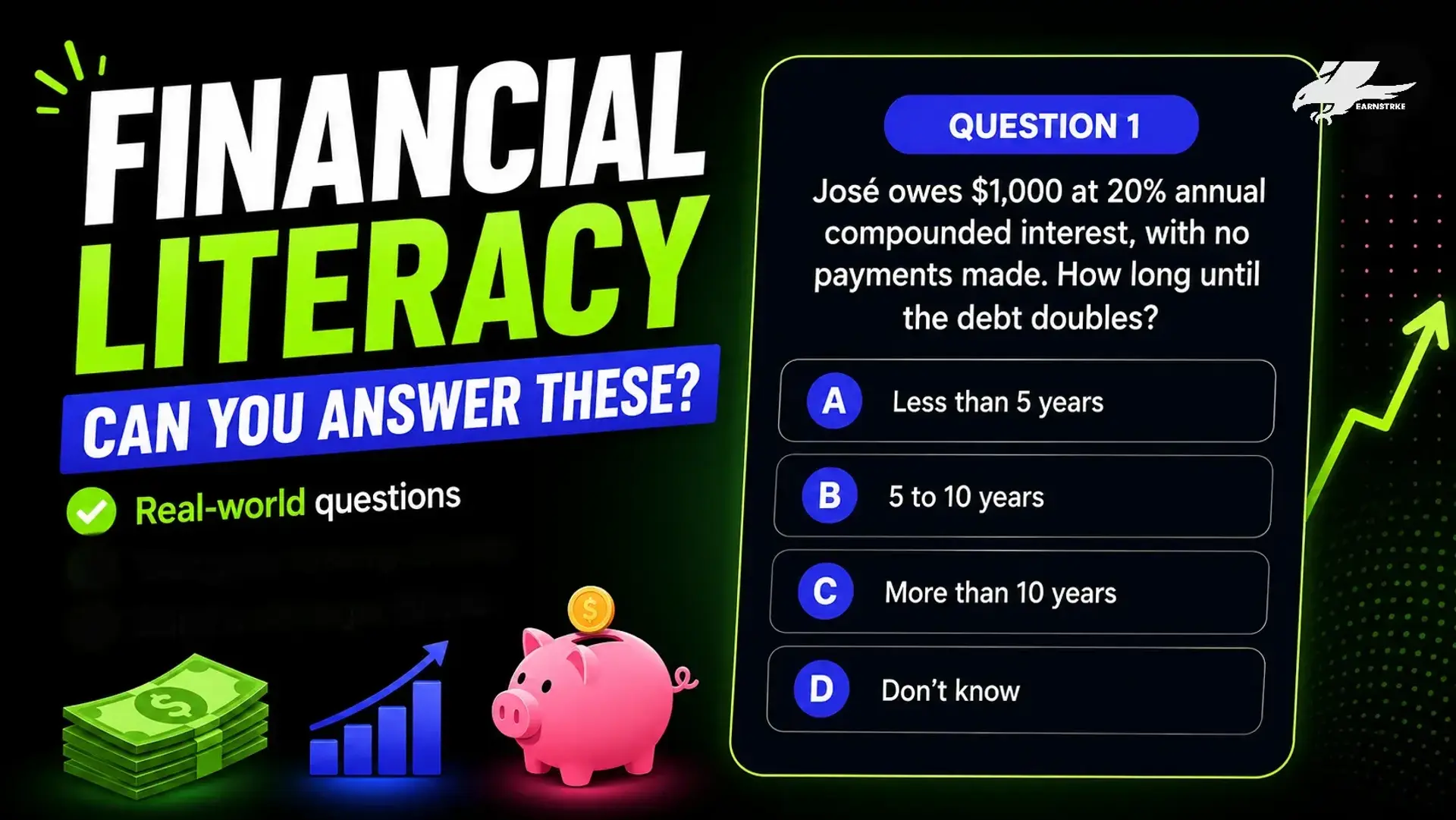
D) Don't know - José owes $1,000 at 20% annual compounded interest, with no payments made. How long until the debt doubles?
A) Less than 5 years
B) 5 to 10 years
C) More than 10 years
D) Don't know - Katherine is a healthy, single 25-year-old worker. What insurance does she most likely need in the near term?
A) Life insurance
B) Disability insurance
C) Long-term care insurance
D) Don't know - Lottery A pays $200 with a 5% chance of winning. Lottery B pays $90,000 with a 0.01% chance. Which has greater expected winnings?
A) Lottery A
B) Lottery B
C) They're equal
D) Don't know - Which is inappropriate investment advice for the person described?
A) A stock index fund for a 30-year-old saving for retirement
B) A bond fund for part of a 60-year-old's retirement savings
C) A small startup stock fund for a 75-year-old retiree
D) Don't know
Answer Key: How Many Did You Get Right?
- C — Training courses build skills, which raises earning potential. 56% of adults got this right.
- A — A budget plans spending; it doesn't track assets. 49% got this right.
- A — Inflation (3%) outpaced her return (2%), so her purchasing power fell. 48% got this right.
- B — Diversification spreads risk across companies and industries. 54% got this right.
- A — At 20% compounded annually, debt roughly doubles in under 5 years. Only 40% got this right.
- B — A young worker's biggest financial risk is losing income to illness or injury, which is what disability insurance covers. Only 27% got this right — the single hardest question on the quiz.
- A — Lottery A's expected value is $10 (5% × $200). Lottery B's is $9 (0.01% × $90,000). 46% got this right.
- C — High-risk growth stocks are generally a poor fit for a 75-year-old retiree's portfolio. 46% got this right.
How Did the Average American Score?
Score yourself, then compare:
- 7–8 correct: 15% of adults landed here — very strong literacy
- 5–6 correct: 24% of adults
- 3–4 correct: 24% of adults
- 0–2 correct: 36% of adults — very low literacy
That last number is the headline. More than a third of U.S. adults got two or fewer questions right out of eight.
Where Did Most People Lose Points?
Two questions stand out as the hardest, and they're not abstract trivia — they're decisions people make constantly.
The disability insurance question (Q6) had the lowest correct rate at 27%. Most people associate insurance with life insurance or long-term care, not income protection. But statistically, a 25-year-old is far more likely to face a temporary disability that stops them from working than to die young or need nursing care.
The compound interest question (Q5) came in second-worst at 40%. Most adults underestimate how fast debt compounds at high interest rates — a knowledge gap that lines up directly with how easily people get trapped by high-APR credit cards and personal loans.
Who Scores Lowest, and Why Does It Matter?
The gaps break down sharply by age and gender. Men averaged 49% correct on the P-Fin 8, compared with 42% for women. Gen Z averaged just 38% correct, with nearly half of that generation answering two or fewer questions right.
This isn't just a trivia gap. The full P-Fin Index has tracked a steady decline in literacy nationally — the share of adults with very low financial knowledge grew from 20% in 2017 to 25% in 2026. TIAA Institute head Surya Kolluri said financial literacy has never been lower, calling it a clear signal that Gen Z is entering adulthood without the foundational knowledge it needs.
The pattern holds across the broader index too: comprehending risk is the single weakest category for every generation, with only 36% of risk-related questions answered correctly across the entire 28-question survey.
FAQ
What is the P-Fin Index?
The P-Fin Index is an annual survey by the TIAA Institute and the Global Financial Literacy Excellence Center that measures financial literacy among U.S. adults. It's been running since 2017 and covers eight areas of personal finance, from budgeting to investing to insurance.
What's a good score on the financial literacy quiz?
On the eight-question P-Fin 8, answering 7 or 8 questions correctly puts you in the top 15% of U.S. adults. Getting 5 or 6 right is above the national average of 46%. Scoring 2 or fewer puts you in the bottom 36% of adults surveyed.
Why do most people get the insurance question wrong?
Only 27% of adults correctly identified disability insurance as the coverage a healthy young worker needs most. People tend to associate insurance with death or old age, overlooking the higher near-term risk of losing income to illness or injury.
Is financial literacy getting better or worse in the U.S.?
It's getting worse. The 2026 P-Fin Index recorded the lowest average score in the survey's 10-year history, at 47% correct. The share of adults with very low financial literacy rose from 20% in 2017 to 25% in 2026.
Why does Gen Z score lower on financial literacy tests?
Gen Z averaged just 38% correct on the 2026 P-Fin Index, the lowest of any generation. Researchers haven't pinned down a single cause, but the gap shows up consistently across nearly every category the survey measures, not just one weak area.
Primary Source: 2026 TIAA Institute-GFLEC report
The content on this page is provided for informational and educational purposes only and should not be considered financial or investment advice. Please read our Disclaimer for additional information.