The Top 10 Best Performing ETFs in the Market Right Now
This image is used under our Editorial Policy.
Nine of the ten best-performing ETFs in 2026 are tied to semiconductors or Taiwan, led by the Invesco Semiconductor ETF's 112.38% year-to-date gain, as global chip industry revenue is projected to surpass $1 trillion this year on AI infrastructure demand.
Look at almost any "best ETFs of the year" list right now and it reads like the same sector wearing nine different tickers. That's not a coincidence. It's what happens when one technology shift becomes the dominant driver of an entire asset class.
Which ETFs Are Actually Leading the Market in 2026?
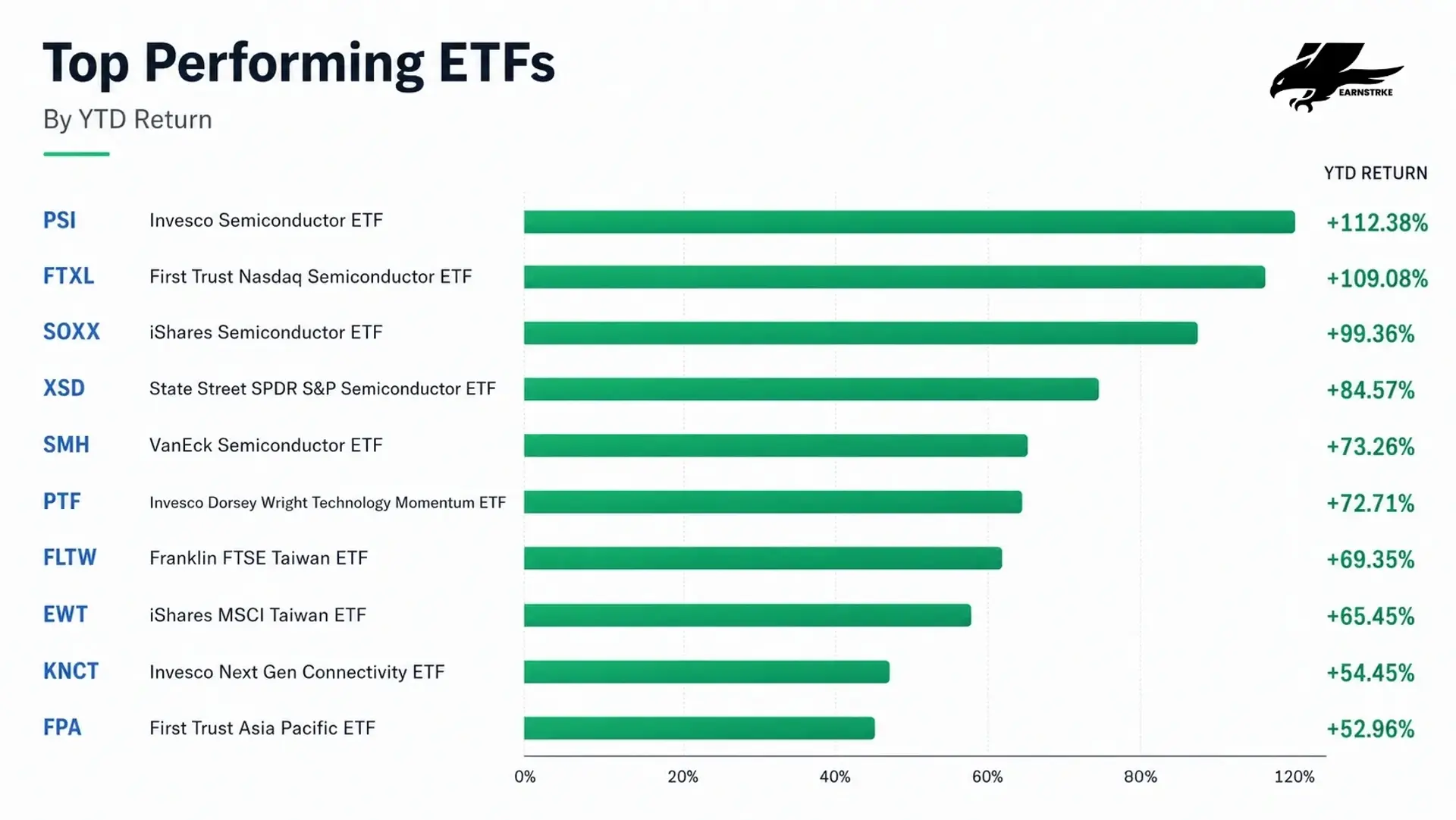
Here's the current leaderboard by year-to-date return:
- Invesco Semiconductor ETF (PSI): +112.38%
- First Trust Nasdaq Semiconductor ETF (FTXL): +109.08%
- iShares Semiconductor ETF (SOXX): +99.36%
- SPDR S&P Semiconductor ETF (XSD): +84.57%
- VanEck Semiconductor ETF (SMH): +73.26%
- Invesco Dorsey Wright Technology Momentum ETF (PTF): +72.71%
- Franklin FTSE Taiwan ETF (FLTW): +69.35%
- iShares MSCI Taiwan ETF (EWT): +65.45%
- Invesco Next Gen Connectivity ETF (KNCT): +54.45%
- First Trust Asia Pacific ex-Japan ETF (FPA): +52.96%
Seven of those ten are direct semiconductor plays. The two Taiwan funds aren't really a separate story either, since Taiwan Semiconductor Manufacturing Company dominates global chip fabrication and pulls those country funds along for the ride. This isn't diversified outperformance. It's one trade showing up under ten different names.
Why Is the Semiconductor Trade This Dominant?
Global semiconductor industry revenue is projected to climb 64% in 2026 to $1.32 trillion, and the driver behind that growth has shifted from a single company's GPUs to the entire chip supply chain.
For most of 2024 and early 2025, the AI rally was largely a Nvidia story. That's no longer true. AMD's stock has surged more than 130% year-to-date through early June 2026, while Micron's roughly 180% year-to-date rally turned high-bandwidth memory into one of the sector's strongest individual narratives. Memory chips, networking silicon, and power management components are now pulling their own weight in fund returns rather than riding Nvidia's coattails.
Tejas Dessai, director of thematic research at Global X ETFs, described the shift as visible on three fronts: the move from general-purpose processors to AI-optimized chips, the use of high-bandwidth memory to handle AI's data intensity, and the rise of ultra-fast interconnect technology that links AI servers together.
The spending behind all of it is coming from a small group of companies writing very large checks. Alphabet, Microsoft, Amazon, and Meta have collectively pushed projected 2026 capital expenditure toward $725 billion, almost entirely tied to AI infrastructure: data centers, networking equipment, and custom silicon.
How Concentrated Is the Risk Inside These Funds?
This is the part a simple returns list doesn't show you. Despite tracking "the semiconductor sector" broadly, these ETFs are heavily weighted toward a handful of names.
In SMH, for example, the top ten holdings account for roughly 73% of total assets, with Nvidia alone representing 16.4% of the fund. That means an investor buying SMH for diversification is still taking a meaningfully concentrated bet on a small group of companies, not a broad basket of chip exposure.
Money has followed the performance at a pace that's notable even by 2026 standards. The Roundhill Memory ETF became the fastest ETF in history to reach $10 billion in assets under management, hitting that mark in just 43 days. The two largest semiconductor ETFs each posted record monthly inflows in 2026, more than doubling their previous highs.
Is This Rally Sustainable, or Is It a Bubble?
The bull and bear cases are both backed by real data, and that's what makes this genuinely contested rather than obvious.
The bull case rests on demand that's already showing up in earnings, not just guidance. Nvidia's fiscal 2026 revenue reached $215.9 billion, up 65% year over year, with fourth-quarter data center revenue alone hitting a record $62.3 billion. Industry forecasts put 2026 global semiconductor spending above $1 trillion for the first time, driven by what analysts call agentic AI: systems that reason and act autonomously across multiple steps, requiring different chip architectures than training-focused models did.
The bear case has a specific, well-known name behind it. Michael Burry, who built his reputation predicting the 2008 housing collapse, has taken out substantial put options against the SOXX ETF and several individual chip stocks, with positions expiring in January 2027. His argument centers on velocity: the SOXX ETF has traded as much as 60% above its 200-day moving average, a level of technical extension that historically resolves through either a sharp pullback or a long sideways grind. The sector already demonstrated that fragility in late May 2026, when the SOXX index shed 10% of its value in a matter of days after hotter-than-expected inflation data raised concerns about how long the Federal Reserve would hold rates elevated.
What's the Angle Most Coverage Misses?
Most coverage treats this as a single story: "AI is driving chip stocks higher." The more useful read is that nine different funds posting near-identical performance patterns is itself a risk signal, separate from whether the underlying AI demand is real.
When ten of the top-performing funds in an entire market are this correlated, an investor who thinks they're diversified across different "best ETFs" picks is often holding the same handful of underlying stocks five or six times over, just wrapped in different tickers and expense ratios. The AI infrastructure buildout backing this rally appears to be genuine, supported by actual contracted cloud revenue and real earnings growth rather than pure speculation. But genuine demand and an overcrowded, correlated trade aren't mutually exclusive. Both can be true heading into the second half of 2026.
FAQ
Why are semiconductor ETFs outperforming every other sector in 2026?
Global semiconductor revenue is projected to grow 64% in 2026 to $1.32 trillion, driven by AI infrastructure spending from hyperscalers like Microsoft, Google, Amazon, and Meta. Demand has broadened beyond GPUs to include memory chips, networking silicon, and power management components, lifting the entire chip supply chain rather than a single company.
Why do Taiwan ETFs appear alongside semiconductor ETFs on this list?
Taiwan Semiconductor Manufacturing Company, the world's largest contract chipmaker, dominates global advanced chip fabrication. Taiwan-focused ETFs like EWT and FLTW carry heavy exposure to TSMC and related suppliers, meaning their performance closely tracks the same AI-driven semiconductor demand fueling dedicated chip ETFs.
Are semiconductor ETFs too concentrated to be considered diversified?
Often, yes. Funds like the VanEck Semiconductor ETF hold roughly 73% of assets in their top ten positions, with Nvidia alone representing over 16%. Investors buying these funds for sector diversification are still taking a concentrated bet on a small number of dominant chip companies.
Is the 2026 semiconductor rally considered a bubble?
Opinions are split. Investor Michael Burry has taken significant put option positions against semiconductor ETFs, citing extreme technical extension and comparisons to the 2000 dot-com bubble. Bulls counter that current revenue and earnings growth, including Nvidia's 65% year-over-year revenue increase, reflect real demand rather than pure speculation.
What risks could end the semiconductor ETF rally?
Rising interest rate concerns are a primary risk, as seen in late May 2026 when hotter-than-expected inflation data triggered a 10% pullback in the SOXX index within days. Other risks include geopolitical tensions around Taiwan, valuation extremes, and the possibility that AI infrastructure spending growth decelerates faster than current forecasts assume.
Stock investments involve market risk and price fluctuations. This content is for informational purposes only and should not be considered investment advice. Please read our Disclaimer for more information.