Silver Price Trend 2026: Why Long-Term Story Hasn't Changed
This image is used under our Editorial Policy.
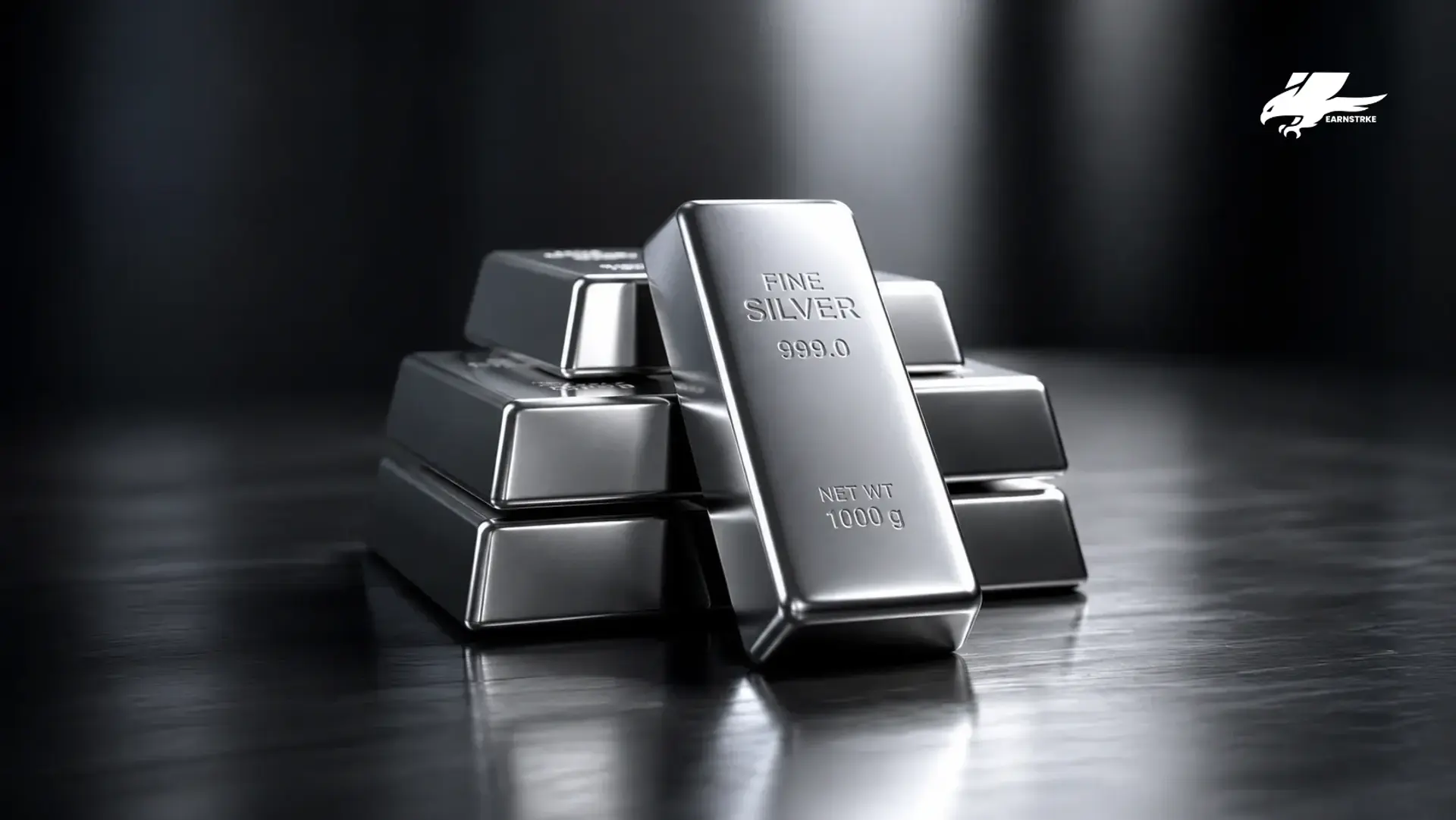
If you bought silver at the wrong moment this year, it's been a painful few months. The metal hit an all-time high of $121.64 per ounce in late January 2026, then spent the following months giving most of that back. As of now it's trading around $64–$65 per ounce internationally — a drop of roughly 44% from the peak. In India, where MCX silver futures were touching ₹4.1 lakh per kg earlier in the year, prices have retreated to around ₹2.75 lakh per kg.
That's a steep correction by any measure. But here's the thing: the selloff hasn't actually changed the structural story behind silver. And understanding the difference between a technical correction and a fundamental breakdown matters a lot before drawing any conclusions about where this metal is headed.
What Caused the Drop
The decline wasn't driven by some sudden collapse in demand or a discovery of massive new silver reserves. It was, by most accounts, a technical unwind.
CME Group raised margin requirements for silver positions, which forced leveraged traders to close out bets quickly. A stronger U.S. dollar added downward pressure, as it typically does for dollar-priced commodities. And after silver had already rallied around 147% through 2025 — going from roughly $30 per ounce at the start of that year to nearly $79 by January 2026 — some degree of profit-taking was probably inevitable.
None of that touches the underlying demand picture. Analysts across the board have been fairly consistent on this point: the fundamentals haven't moved.
Six Years of Deficit and Counting
One of the most important facts about silver that tends to get lost in price discussions is this: the world has been consuming more silver than it mines every single year since 2021. By current estimates, 2026 is on track to be the sixth consecutive year of global supply deficit.
That's not a short-term blip. It's a structural gap that gets harder to close every year, partly because of how silver is actually produced. Unlike gold, which has dedicated mining operations, the majority of silver comes out of the ground as a byproduct of copper and zinc mining. That means supply growth is largely tied to demand for other metals rather than silver prices themselves — which limits how quickly production can respond when demand spikes.
On the demand side, more than half of silver's annual consumption is industrial, and much of it is permanently used up in the process. It doesn't go back into the market the way stored gold does.
The AI, Solar and EV Connection
This is where silver's story gets genuinely interesting for the long term — and where it diverges most sharply from gold's narrative.
Solar panels are among the largest industrial consumers of silver, and global solar installations continue to break records year after year. Silver paste is used in photovoltaic cells, and there's currently no widely adopted substitute that matches its conductivity. As countries race to expand renewable energy capacity, silver demand from this sector alone is expected to grow significantly through the rest of the decade.
Electric vehicles add another layer. The estimate that EVs require roughly twice as much silver as a conventional combustion engine vehicle — because of their higher electrical complexity — means every percentage point gain in EV adoption translates into real additional silver demand.
Then there's artificial intelligence. This one is newer but increasingly significant. Silver is the most electrically conductive metal on earth, which makes it relevant in servers, semiconductors, and the thermal management systems that keep AI data centers running. As spending on AI infrastructure continues to accelerate globally, the technology sector is quietly becoming a meaningful driver of silver consumption — a trend that barely registered a few years ago.
Silver Is Now Moving Inflation Needles in India
Here's a data point that illustrates just how embedded silver has become in real economic activity. According to SBI Research's latest report, silver jewellery was the single largest individual contributor to India's headline inflation in May 2026, adding 56 basis points on its own. Gold contributed 30 basis points, petrol 14. Silver also pushed up the personal care category by nearly 80 basis points in the same month.
India's government noticed. The country's silver import bill hit a record $12 billion in FY26, more than double the $4.8 billion from the previous year, with April alone seeing imports jump 157% year-on-year. In response, the government moved additional silver forms into the restricted import category and raised import duties on both gold and silver from 6% to 15%.
That's not a small policy adjustment. It reflects how seriously the government is treating silver's role in the country's trade balance.
Interest Rates, the Dollar and What History Says
Silver's relationship with interest rates is worth understanding because it shapes how the metal behaves during different economic cycles. When rates rise, yield-bearing assets like bonds become more attractive, and silver — which pays nothing to hold — tends to lose appeal. When rates fall, the calculus reverses.
Looking back, when the Federal Reserve's effective funds rate sat near zero in early 2021, silver was trading around $25 per ounce. By January 2024, with rates above 5%, it had drifted down to around $22.77. By January 2026, as rates came back down to 3.64%, silver had climbed to $72.82.
The pattern isn't perfectly linear, but the direction is consistent. A Fed that continues easing — or holds off on hikes — is generally a supportive environment for silver.
Where Analysts Think This Goes
The range of forecasts for silver by year-end 2026 is wide, which is honest — nobody actually knows with certainty. Bank of America's commodity desk has been among the more vocal institutions making the bull case, projecting prices moving substantially higher from current levels, though the bank acknowledges that Fed policy and dollar direction will play a significant role in how quickly that plays out.
Goldman Sachs has similarly flagged silver as one of the commodities with the strongest structural demand tailwinds heading into the second half of the decade, pointing specifically to the solar and energy transition angle as a driver that isn't going away regardless of short-term macro noise.
JPMorgan's commodity strategists have noted that the current correction looks more like a positioning reset than a trend reversal — the kind of move that happens after a 147% rally, not the kind that signals a multi-year top.
The correction from January's highs was real and it hurt. But the supply deficit is real too. The solar installations are real. The EV transition is real. The AI buildout is real. Silver sits at the intersection of all of them — which is exactly why, despite a rough first half, the biggest names in commodities research aren't writing off the long-term case just yet.
Commodities markets can be volatile and affected by global events. This content is for informational purposes only and should not be considered investment advice. Please read our Disclaimer for more information.