ASTS BlueBird 8-9-10 Launchs: What Investors Need to Know
This image is used under our Editorial Policy.
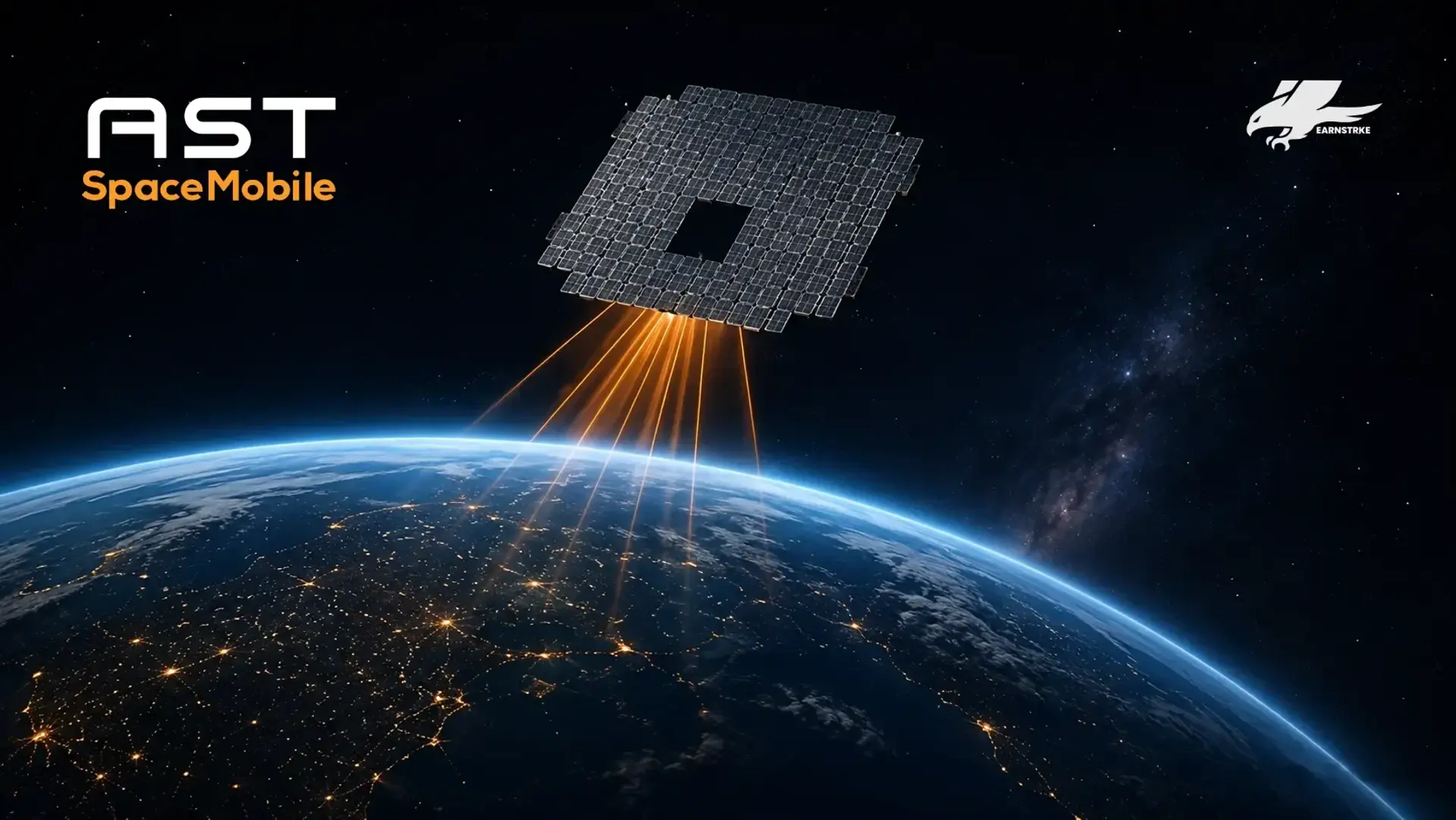
On June 17, 2026, AST SpaceMobile (NASDAQ: ASTS) is scheduled to launch BlueBird 8, 9, and 10 aboard a SpaceX Falcon 9 from Cape Canaveral — the first simultaneous deployment of three Block 2 satellites, each carrying the largest commercial phased-array antenna ever built for low Earth orbit, and the most consequential test of the company's execution since its satellite program began.
If it goes to plan, this is a genuine engineering milestone. If it doesn't, ASTS has another BlueBird 7 situation on its hands — and investors already know how that plays out.
What Makes BlueBird 8, 9, and 10 Different From Earlier Satellites?
These are Block 2 units — a meaningful step up from the first generation. Each satellite carries a phased-array antenna spanning approximately 2,400 square feet. That's not just big for a commercial satellite; it's the largest commercial array ever built for LEO, period.
Block 1 BlueBirds already recorded 98.9 Mbps peak download speeds directly to standard smartphones — no specialized hardware, no satellite dish, no modifications to the phone. Block 2 is expected to nearly double that figure.
Liftoff is targeted for 2:39 a.m. EDT on June 17, with a backup window at 4:15 a.m. EDT. If needed, a secondary opportunity opens June 18 at 2:19 a.m. EDT. The Falcon 9 first-stage booster supporting this mission is on its 29th flight. After stage separation, it is expected to land on the droneship A Shortfall of Gravitas in the Atlantic Ocean. A live webcast begins approximately 15 minutes before liftoff on SpaceX's channels.
Why Does This Launch Matter So Much for ASTS?
Context matters here. BlueBird 7 failed to reach its intended orbit in April 2026 when Blue Origin's New Glenn-3 rocket placed it too low for the satellite's thrusters to compensate. It powered on, separated cleanly, then had to be de-orbited. ASTS said insurance would cover the loss, but the stock fell roughly 15% overnight. It was a reminder that launch risk is real and priced in fast.
BlueBirds 8, 9, and 10 arriving at Cape Canaveral and proceeding to launch on a Falcon 9 — a far more proven rocket — has already provided some relief. ASTS shares jumped roughly 6.8% when the June 17 date was confirmed on June 9.
Q1 2026 earnings were a different story. Revenue came in at $14.7 million against a Wall Street consensus of $37.5 million. The quarterly loss was $0.66 per share — three times the year-ago figure. Management flagged higher capital expenditures ahead for Q2 and continued execution risk on launch schedules. Deutsche Bank downgraded ASTS from Buy to Hold and cut its target to $106 from $117 after the miss.
The stock is up 18.2% over the past 30 days but down 24.9% over the past week heading into launch. It trades like a story stock — because that's exactly what it is.
Who Owns ASTS — and What Does That Tell You?
The shareholder list says a lot about the thesis.
- Abel Avellan, CEO and founder: 78,163,078 shares — the largest single holder by a wide margin
- Vanguard Group: 21,488,180 shares
- BlackRock: 14,517,234 shares
- Vanguard Capital Management: 11,489,121 shares
- Alphabet (Google): 8,943,486 shares
- State Street: 5,585,487 shares
- Vodafone Ventures: 5,471,743 shares
Alphabet and Vodafone aren't passive index holders — they're strategic partners with a direct interest in AST SpaceMobile's network succeeding. Google needs connectivity for its ecosystem. Vodafone needs a satellite fallback for its mobile subscribers. Their stakes are bets on the product, not just the stock.
What Is the Japan J-LEO Contract and Why Does It Matter?
Japan is expected to name the winner of its J-LEO project later this month — potentially the second major catalyst for ASTS in June. J-LEO is a ¥150 billion (~$1 billion) initiative to build a nationwide direct-to-smartphone satellite network with disaster-resilient coverage by 2029.
Two partnerships are competing: KDDI paired with SpaceX, and Rakuten Mobile backed by AST SpaceMobile.
Rakuten is already a named strategic partner in AST SpaceMobile's commercial ecosystem. A J-LEO win would hand ASTS a national-scale contract in one of the world's most advanced mobile markets — and validate its commercial model in Asia at the exact moment it's scaling manufacturing. A loss to SpaceX doesn't kill the story, but it removes a near-term catalyst investors have been counting on.
ASTS is already targeting scaled commercial service in Japan as part of its broader 2026 rollout, per its Q1 2026 SEC filing. Winning J-LEO and activating commercial service in Japan simultaneously would compress what was expected to be a multi-year revenue ramp into a single quarter of news flow.
What Does ASTS's Path to 45 Satellites Actually Look Like?
The company targets approximately 45 BlueBird satellites in orbit by end of 2026. BlueBirds 11 through 33 are in advanced production stages. Phased arrays are completed through BlueBird 28. That's a real manufacturing pipeline, not a slide-deck promise — AST SpaceMobile operates over 500,000 square feet of production space globally.
Full-year 2026 revenue guidance stands at $150 million to $200 million, backed by more than $1.2 billion in contracted revenue commitments from partners and roughly $3.5 billion in cash as of March 31, 2026. The balance sheet isn't the concern. Whether launches keep going to plan is.
FAQ
What are the BlueBird 8, 9, and 10 satellites?
They're AST SpaceMobile's next-generation Block 2 satellites, each carrying a phased-array antenna spanning roughly 2,400 square feet — the largest commercial arrays ever built for LEO. Scheduled for June 17, 2026 on a SpaceX Falcon 9, they're expected to deliver nearly double the peak data speeds of Block 1 units, which already achieved 98.9 Mbps directly to unmodified smartphones.
What happened to BlueBird 7?
In April 2026, Blue Origin's New Glenn-3 rocket placed BlueBird 7 into a lower orbit than planned. The satellite separated and powered on but couldn't sustain operations, and AST SpaceMobile confirmed it would de-orbit. Insurance is expected to cover the cost. ASTS shares dropped 15% overnight on the news — the clearest illustration of how much launch outcomes move this stock.
What is the Japan J-LEO project and how is ASTS involved?
J-LEO is Japan's roughly $1 billion initiative to build a nationwide direct-to-smartphone satellite network by 2029. AST SpaceMobile, partnered with Rakuten Mobile, is competing against a KDDI-SpaceX bid for the contract. Japan is expected to announce the winner in late June 2026. A win would be a major commercial milestone for ASTS in the Asia-Pacific region.
Who are the biggest shareholders of AST SpaceMobile?
CEO Abel Avellan holds the largest individual stake at over 78 million shares. Vanguard and BlackRock are the dominant institutional holders. Alphabet and Vodafone Ventures also hold meaningful positions — both are active commercial partners, making their stakes a strategic product bet as much as a financial investment.
What is ASTS's 2026 revenue guidance?
AST SpaceMobile has guided for $150 million to $200 million in full-year 2026 revenue, primarily driven by mobile network operator partners and the U.S. government. The company holds roughly $3.5 billion in cash as of March 31, 2026, and has secured more than $1.2 billion in contracted revenue commitments from partners.
The content on this page is provided for informational and educational purposes only and should not be considered financial or investment advice. Please read our Disclaimer for additional information.