Inside NASA: The ETF Built Around the Space Economy
This image is used under our Editorial Policy.
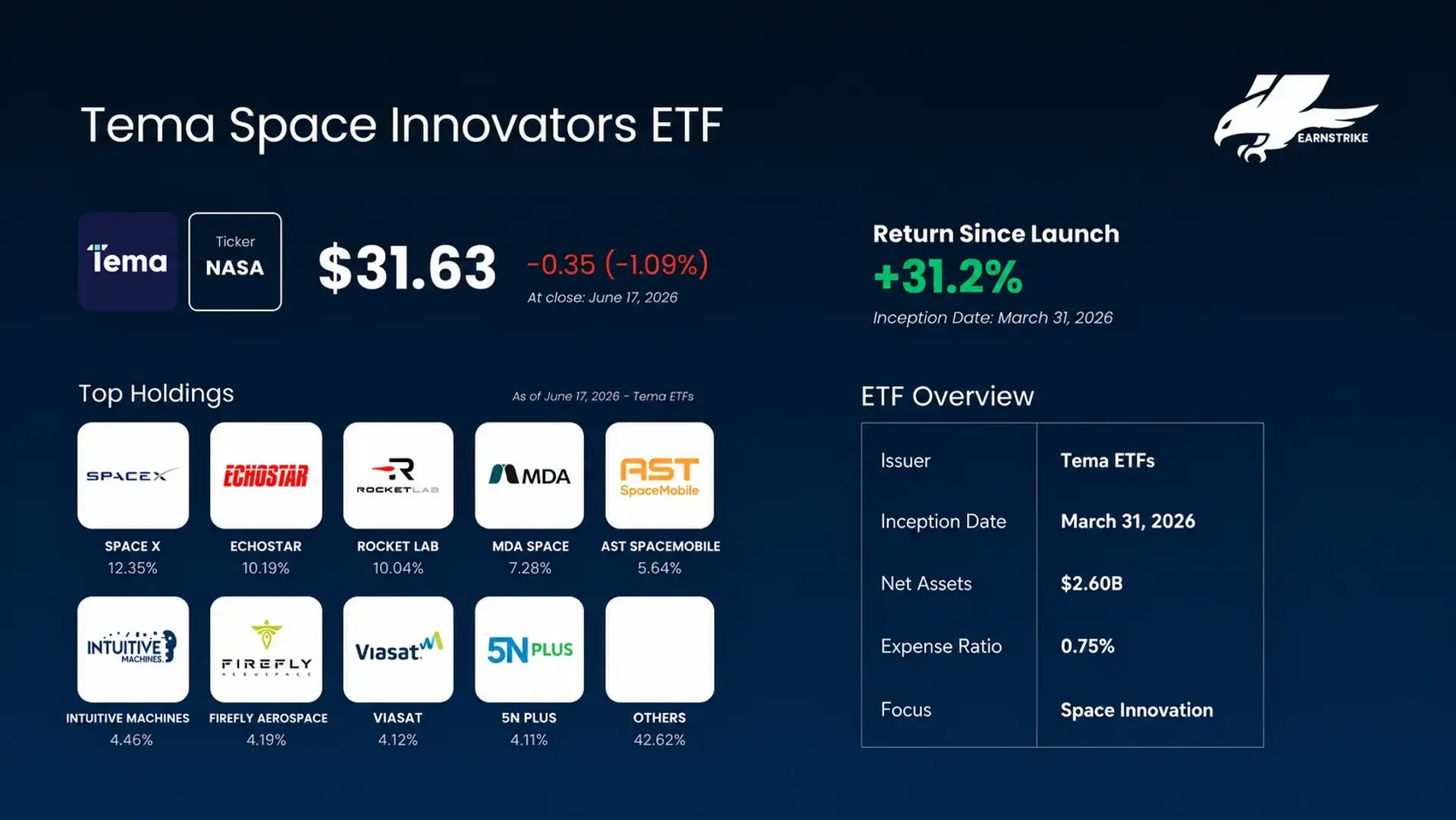
The Tema Space Innovators ETF, trading under the ticker NASA, has grown to approximately $2.7 billion in assets since its March 31, 2026 launch and delivered a 31.2% return through June 16, 2026, built on a 42-stock portfolio spanning rocket launch, satellite operations, and ground equipment companies.
Let's clear up the obvious confusion first. NYSE ticker NASA has nothing to do with the U.S. government space agency. It's an actively managed ETF run by Tema ETFs, and the ticker is a branding choice that's clearly worked. In under three months, the fund went from a launch nobody had heard of to one of the fastest asset-gathering runs in ETF history.
What Is the Tema Space Innovators ETF Actually Built On?
NASA is an actively managed fund, which means a team of investment managers picks and adjusts holdings rather than tracking a fixed index. That structure lets the fund move with the space economy as it evolves, rather than locking in a static list of companies.
The fund holds 42 stocks total, with the top ten positions making up roughly 58% to 60% of the portfolio. Geographically, the United States accounts for 65.89% of holdings, followed by Canada at 12.19%, Japan at 5.43%, Taiwan at 4.43%, and other countries making up the remaining 12.06%.
By industry, the breakdown looks like this:
- Industrials: 47.96%
- Communication Services: 21.57%
- Information Technology: 19.54%
- Materials: 4.11%
That mix tells you NASA isn't just rocket companies. It's the physical and communications backbone of the space economy: launch providers, satellite operators, component manufacturers, and the materials suppliers feeding all of it.
How Has NASA Grown So Quickly?
NASA crossed $1 billion in assets in just 37 trading days after launch, one of the fastest climbs to that milestone for any thematic ETF. By mid-June 2026, total assets reached approximately $2.70 billion.
Part of that growth came from a structural feature most thematic ETFs don't have: access to select pre-IPO opportunities. NASA holds a position in SpaceX through a special purpose vehicle, a private investment structure that let the fund take a stake in the company while it was still privately held. That position is subject to a lockup period of at least 180 days following SpaceX's IPO, after which the shares convert to freely tradable stock. As of mid-June 2026, SpaceX represented approximately 5.5% of NASA's total portfolio, making it one of the fund's holdings rather than its defining feature.
What Else Is in NASA's Portfolio Beyond SpaceX?
This is where the fund's actual diversification shows up. NASA spreads its capital across the full supply chain of the commercial space economy, not just the highest-profile name in it.
NASA's largest holdings, as of June 17, 2026, include:
- SpaceX
- EchoStar
- Rocket Lab
- MDA Space
- AST SpaceMobile
- Intuitive Machines
- Firefly Aerospace
- Viasat
- 5N Plus
Beyond these top names, the remaining portfolio fills out the rest of the supply chain: component and ground equipment suppliers, satellite manufacturers, and materials companies feeding the broader sector. Rather than betting on which single company wins the space race, NASA is positioned across the companies that profit regardless of which launch provider or satellite operator comes out ahead in any given year.
What's the Angle Most Coverage Misses?
Most coverage of NASA fixates on its SpaceX access because that's the easiest story to tell. The more durable story is the supply chain layer underneath it.
Component and infrastructure suppliers feeding into multiple space companies at once, rather than betting on a single operator, are often smaller, less followed, and simply don't show up in passive space indices. Finding and weighting those companies correctly requires actual research into who supplies what to whom across the sector, not a screen for "space" in a company description. That's the part of NASA's active management that's harder to replicate with a passive fund, and it's also the part of the portfolio least dependent on any single company's stock price on any given day.
FAQ
Is the NASA ETF affiliated with the government space agency?
No. NYSE ticker NASA belongs to the Tema Space Innovators ETF, an actively managed fund from Tema ETFs LLC. The National Aeronautics and Space Administration has no affiliation with the fund, has not endorsed it, and played no role in its creation, according to the fund's own disclosures.
What companies does the NASA ETF actually hold?
NASA holds 42 stocks spanning rocket launch and propulsion, satellite operations and manufacturing, ground equipment, radio frequency components, and materials suppliers. The portfolio is concentrated by industry in Industrials at 47.96%, Communication Services at 21.57%, and Information Technology at 19.54%.
Does the NASA ETF include SpaceX?
Yes. NASA holds a position in SpaceX acquired through a special purpose vehicle before the company's IPO. As of mid-June 2026, that position represented approximately 5.5% of the fund's total portfolio, making it one of NASA's many holdings rather than its primary focus.
How much has the NASA ETF grown since launch?
NASA crossed $1 billion in assets within 37 trading days of its March 31, 2026 launch and reached approximately $2.70 billion by mid-June 2026. The fund returned approximately 32.7% over that same period, reflecting strong investor demand for active, diversified exposure to the space economy.
What is NASA's expense ratio?
NASA charges a 0.75% expense ratio, which is typical for actively managed thematic ETFs covering specialized sectors like the space economy. That fee reflects the active research and portfolio management involved in identifying companies across the full space supply chain, rather than tracking a fixed index.
Stock investments involve market risk and price fluctuations. This content is for informational purposes only and should not be considered investment advice. Please read our Disclaimer for more information.