Call and Put Options: Finally Explained Without the Jargon
This image is used under our Editorial Policy.
If you've ever tried to learn about options trading and walked away more confused than when you started, you're not alone. Most explanations either drown you in financial terminology within the first paragraph or assume you already understand half the concepts they're supposedly explaining. The result is that options remain this mysterious, slightly intimidating corner of investing that most people avoid entirely — even though the core idea behind them is actually not that complicated.
So let's slow it down. No Greek letters yet. No complex diagrams. Just the actual concept, explained the way it should have been explained to you the first time.
What Is an Option?
An option is a contract. That's it — at its core, it's just an agreement between two parties.
That contract gives one person the right — but not the obligation — to buy or sell something at a specific price, before or on a specific date. The "something" is usually shares of a company's stock. The "specific price" is called the strike price. The "specific date" is called the expiration date.
The key phrase in there is "the right but not the obligation." This is what separates options from simply buying or selling stock. When you buy a share of a company, you own it — you're committed. When you buy an option, you have a choice. You can act on it or let it expire. That flexibility is exactly what makes options both useful and, when misused, dangerous.
There are only two types of options. A call option and a put option. Everything else in the options world — the strategies, the combinations, the complexity — is built on top of these two simple ideas.
Call Options: The Right to Buy
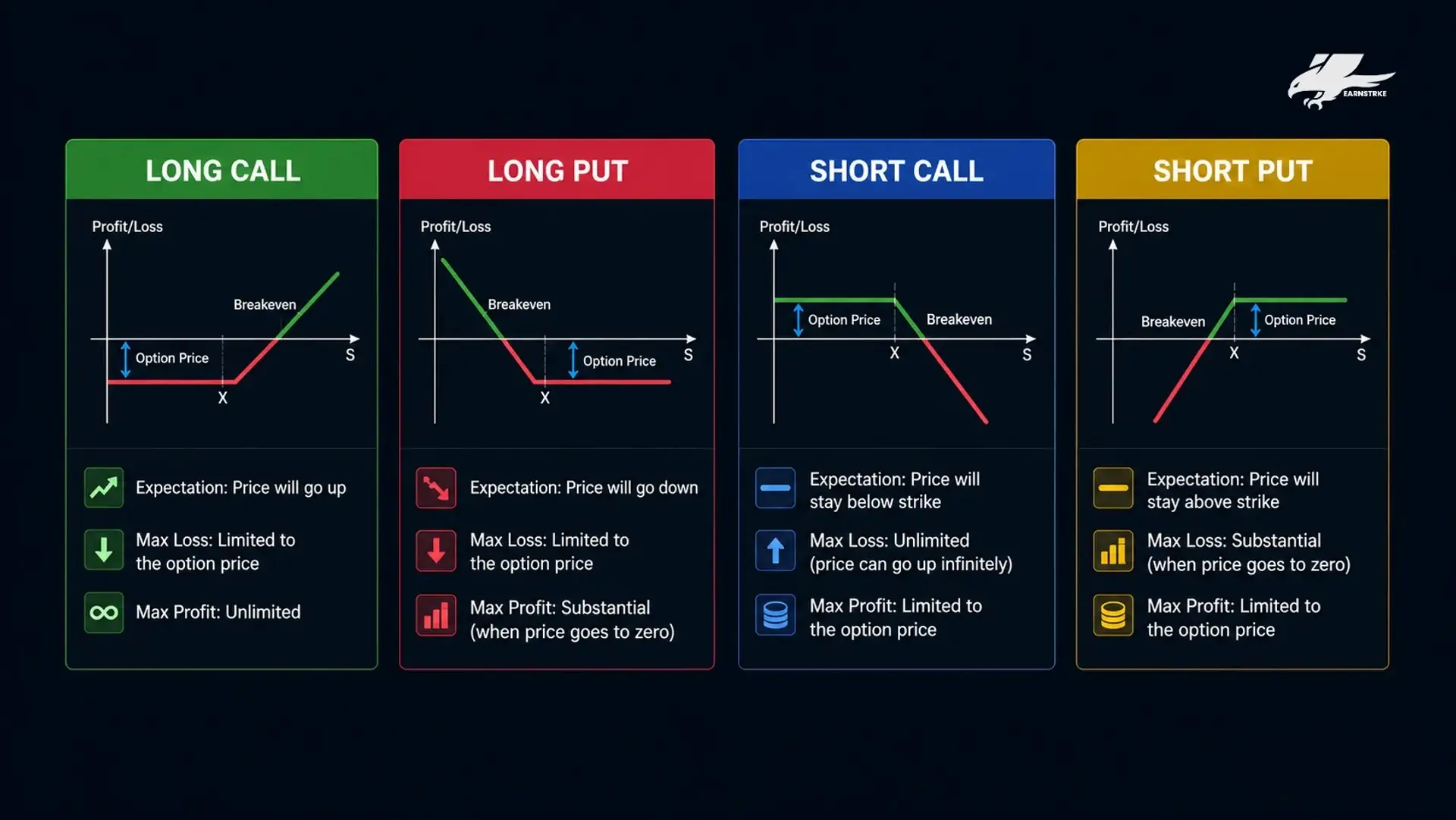
A call option gives you the right to buy a stock at a set price before the contract expires.
Here's a real-world analogy that actually works. Imagine you're interested in buying an apartment. The seller agrees to hold it for you at today's price — let's say $200,000 — for the next three months. You pay them a small fee for that agreement, say $2,000. Now you have three months to decide.
If the apartment's value rises to $250,000 during those three months, your deal looks fantastic. You can still buy it at $200,000, the price you locked in. You've effectively saved $50,000. That $2,000 fee you paid was absolutely worth it.
If the apartment's value drops to $170,000, you simply don't exercise your right to buy. You walk away. You lose the $2,000 fee, but that's all. You're not forced to buy something at $200,000 when it's now worth less.
That's a call option. Replace the apartment with a stock and that's exactly how it works.
In investing terms: you buy a call option when you believe a stock's price is going to go up. If you're right, you profit. If you're wrong, the most you lose is what you paid for the option — called the premium.
A Simple Numbers Example
Let's say a company's stock is currently trading at $50 per share. You believe it's going to rise significantly over the next two months. You buy a call option with a strike price of $55, expiring in two months. The premium costs you $3 per share — and since each options contract typically covers 100 shares, you pay $300 total.
Now two scenarios play out:
Scenario A — You were right. The stock rises to $70. Your contract lets you buy at $55. You immediately have $15 per share of profit built in ($70 minus $55). Multiply that by 100 shares and that's $1,500. Subtract your $300 premium and your net profit is $1,200. You turned $300 into $1,500. That's the leverage people talk about with options.
Scenario B — You were wrong. The stock drops to $40. Your right to buy at $55 is now worthless — nobody would exercise the right to buy at $55 something that's trading at $40 in the open market. The option expires. You lose your $300 premium. That's the full extent of your loss.
This is why people say options give you leverage with defined risk on the buying side. The upside can be significant. The downside is capped at what you paid.
Put Options: The Right to Sell
A put option is the opposite. It gives you the right to sell a stock at a set price before the contract expires.
People buy puts when they believe a stock's price is going to fall. It's essentially a way to profit from a decline — or to protect a position you already hold from losing too much value.
Back to the real-world analogy. Imagine you own that apartment worth $200,000. You're worried the property market might crash in the next few months. You find someone willing to agree — for a fee — that they'll buy your apartment at $200,000 no matter what happens to the market over the next three months.
If the market crashes and your apartment drops to $140,000, you can still sell at $200,000. That agreement just saved you $60,000 in losses. The fee you paid for that protection was worth every penny.
If the market holds strong and your apartment rises to $230,000, you simply don't use the agreement. You sell at market price instead and pocket the gain. You lost the fee, but you made more than that in appreciation.
That's a put option. In stock market terms: you buy a put when you think a stock is going to drop, or when you already own the stock and want insurance against a decline.
The Numbers Example for Puts
The same stock, trading at $50. This time you think it's going to fall. You buy a put option with a strike price of $45, expiring in two months. Premium costs $3 per share, so $300 for one contract.
Scenario A — You were right. The stock drops to $30. Your contract lets you sell at $45. That's $15 per share above the current market price. On 100 shares that's $1,500, minus your $300 premium — net profit of $1,200. You profited from the stock falling without ever owning it.
Scenario B — You were wrong. The stock rises to $65. Nobody would exercise the right to sell at $45 something worth $65. The option expires worthless. You lose your $300 and nothing more.
The Two Sides of Every Contract
Here's something that gets glossed over in most beginner explanations: for every option contract that exists, someone is on the other side of it. When you buy a call, someone else sold that call. When you buy a put, someone else sold that put.
The person selling the option is called the option writer. And their experience is the mirror image of the buyer's.
When you buy a call and profit because the stock rose, the person who sold you that call is losing money. When your option expires worthless and you lose your premium, the seller of that option keeps your premium as pure profit.
This is why selling options — also called writing options — is a completely different risk profile from buying them. Buyers have limited downside and theoretically unlimited upside. Sellers collect the premium upfront but can face significant losses if the market moves sharply against them.
Neither side is inherently better. They serve different purposes and suit different strategies.
Why Do Options Have Value?
An option's price — the premium you pay — isn't random. It's made up of two components.
Intrinsic value is the straightforward part. It's how much the option is worth right now if you exercised it immediately. A call option with a $50 strike price on a stock trading at $60 has $10 of intrinsic value. It's already profitable — traders call this being "in the money."
Time value is the less obvious part. Even an option that isn't currently profitable has some value, because there's still time for the stock to move in your favor before expiration. The more time remaining, the more time value an option carries. As expiration approaches, this time value erodes — slowly at first, then faster toward the end. Traders call this time decay, and it works against option buyers while working in favor of option sellers.
This is why simply buying options and holding them without a plan tends to go wrong for beginners. Every day that passes without the stock moving in your direction, your option loses a little value — even if the stock price doesn't move at all.
A good real-world example of speculation driving options activity is the anticipation around SpaceX's long-awaited IPO. As one of the most talked-about potential listings in recent memory, trader interest in any options tied to its valuation has been intense — exactly the kind of event that drives call option volume through the roof as investors try to position themselves ahead of a major price move.
So Why Do People Use Options?
People use options for three main reasons.
Speculation — using relatively small amounts of money to make leveraged bets on where a stock is going. The potential returns are amplified compared to just buying the stock outright, but so is the risk of losing everything you put in.
Hedging — using options to protect existing positions. A long-term investor who holds a large stock position might buy puts as insurance against a short-term crash. They're not trying to profit from the drop — they're just protecting against it the way you'd insure a car you care about.
Income generation — selling options to collect premiums regularly. Covered calls, for example, involve selling call options on stocks you already own, collecting the premium as a form of additional income. This is one of the more conservative option strategies and is used widely by long-term investors.
The One Thing to Remember
Options are not inherently dangerous. They're a tool. Like any financial tool, the danger comes from using something you don't fully understand or using it in a way it wasn't designed for.
Most people who blow up their accounts with options do so not because options are unpredictable, but because they went in without a plan, bet too much of their capital, and didn't account for time decay eating away at their position while the stock went sideways.
Understand what you own. Know your maximum loss before you enter any trade. Never put more into an option than you're genuinely prepared to lose entirely. Those three rules alone would save most beginners from the mistakes that give options their scary reputation.
The concept itself — the right but not the obligation to buy or sell at a fixed price — is actually one of the most elegant ideas in all of finance. Once it clicks, a lot of things about how markets work start making a lot more sense.
The content on this page is provided for informational and educational purposes only and should not be considered financial or investment advice. Please read our Disclaimer for additional information.